

For broader selection context, see Comprehensive Guide to Electroplating Rectifiers: Definition, Working Principle, and Selection.
Electroless nickel plating pump clogging is usually caused by plate-out, crystallization, particle loading, poor filtration turnover, air pockets, incompatible wetted materials, or cleaning residues left inside the circulation loop. The practical fix is not just a larger pump. Engineers should stabilize bath chemistry, remove particles before they seed nickel deposition, choose smooth and compatible pump and filter materials, vent and drain the filter correctly, and set a maintenance routine that prevents deposits from hardening inside the pump, cartridge, and pipework. For a broader pump-filter context in PCB and wet process lines, QEEHUA’s PCB wet process filtration guide explains why the pump and filter should be selected as one circulation loop.
This article focuses on chemical nickel, electroless nickel, chemical nickel-gold, and similar autocatalytic or crystallization-prone baths where a small operating mistake can become a clogged filter, seized pump, unstable plating quality, or an expensive bath dump.
Why Electroless Nickel Pumps and Filters Clog
Electroless nickel is different from ordinary acid or alkali transfer service because the bath is designed to deposit nickel without external current. That is useful on the workpiece, but it also means the bath can deposit onto tank walls, heaters, rough surfaces, filter media, pump internals, or metallic contamination sites if the process becomes unstable. In plating shops this is often called plate-out.
Local QEEHUA source materials flag chemical nickel and chemical gold as easy-to-plate or easy-to-crystallize liquids. They also note that PVDF is often preferred where strong acid resistance, a smoother wetted surface, and lower liquid adhesion are important. That does not make one material universal; it means chemical name, concentration, temperature, pH window, cleaning chemistry, solids load, and supplier limits must all be checked before selecting the pump or filter housing.
Symptoms and Process Risks
A clogged electroless nickel circulation loop often appears first as a quality or pressure problem rather than a visible pump failure. Operators may see rising filter pressure, falling return flow, rough nickel deposits, black particles, dull coating, pitting, short cartridge life, noisy pump operation, or repeated motor overload trips. If the line runs PCB chemical nickel or nickel-gold, the risk is not only filter cost. Particles and unstable circulation can affect hole-wall quality, surface finish, bonding reliability, and yield.
Maintenance teams should also watch for deposit flakes in the filter housing, nickel skin on the pump chamber, blocked pressure gauge diaphragms, crystallized material after shutdown, and hard deposits on valves or dead legs. If these symptoms repeat after every cartridge change, the root cause is probably upstream of the cartridge.
Root Cause Map
Use this map to separate chemical instability from mechanical circulation problems. It helps prevent the common mistake of replacing only the filter element while leaving the same plate-out trigger in the system.
| Observed problem | Likely cause | What to check first | Process consequence |
|---|---|---|---|
| Filter pressure rises quickly after replacement | Particles, nickel plate-out, undersized media, or too fine a cartridge for the contamination load | Cartridge surface, bath age, pre-filtration, turnover, and whether a coarser guard stage is needed | Short cartridge life, low circulation, unstable bath cleanliness |
| Pump flow drops but pressure is not very high | Suction restriction, trapped air, worn impeller, bypass leakage, or pump running away from its best operating range | Liquid level, suction pipe diameter, inlet strainer, air leaks, vent valve position, actual flow test | Poor agitation, local hot spots, uneven deposition |
| Hard nickel deposits inside pump or filter | Plate-out seeded by rough surfaces, metal contamination, high temperature, high pH, poor passivation, or local stagnation | Tank components, heater area, dead legs, pump chamber, pipe supports, metallic fines, cleaning history | Bath loss, downtime, repeated stripping and passivation |
| Crystals after idle time or winter shutdown | Cooling, evaporation, dead liquid pockets, or failure to drain/rinse after shutdown | Pipe low points, pump cavity, filter drain, insulation, heat tracing, shutdown SOP | Blocked impeller, blocked cartridge, startup overload |
| Particles still return to the bath | Filter short circuit, damaged cartridge, loose center rod, twisted O-ring, leaking bypass valve | Flow path, cartridge compression, sealing surface, bypass valve leakage, venting sequence | Rough deposit, pinholes, PCB particle defects |
Field Diagnostic Sequence
Start with the bath and system history. Ask when the problem began, whether chemistry additions changed, whether pH or temperature drifted, whether maintenance recently stripped or passivated the tank, and whether the same cartridges are failing faster than before. Then check the mechanical loop from the tank to the pump, filter, return line, and drain.
A useful field sequence is: confirm tank level and suction immersion, check whether the pump chamber is fully flooded, vent the filter housing until no air remains, compare actual return flow against the expected pump-filter capacity, record filter pressure with a clean cartridge, and inspect the removed cartridge for nickel film, crystals, carbon fines, resin particles, or metal fragments. If particles remain after filtration, use QEEHUA’s filter short-circuit troubleshooting guide to check reversed connections, bypass leakage, O-ring position, cartridge compression, and trapped air.
Do not diagnose electroless nickel clogging from the pressure gauge alone. A blocked pressure diaphragm, air-bound filter, leaking bypass valve, or oversized pump can all give misleading pressure readings.
Pump and Filter Selection
A closely related QEEHUA reference is The Ultimate Guide to Plating Filters: Enhancing Electroplating Quality and Efficiency.
The pump and filter should be specified around bath stability, not just maximum flow. For sensitive chemical nickel service, the filter must remove particles before they seed plate-out, but it should not be so restrictive that cartridges plug immediately and starve the circulation loop. Many chemistry suppliers recommend fine continuous filtration for electroless nickel baths, but the exact micron rating and turnover target should follow the bath supplier’s technical data and the plant’s defect history.
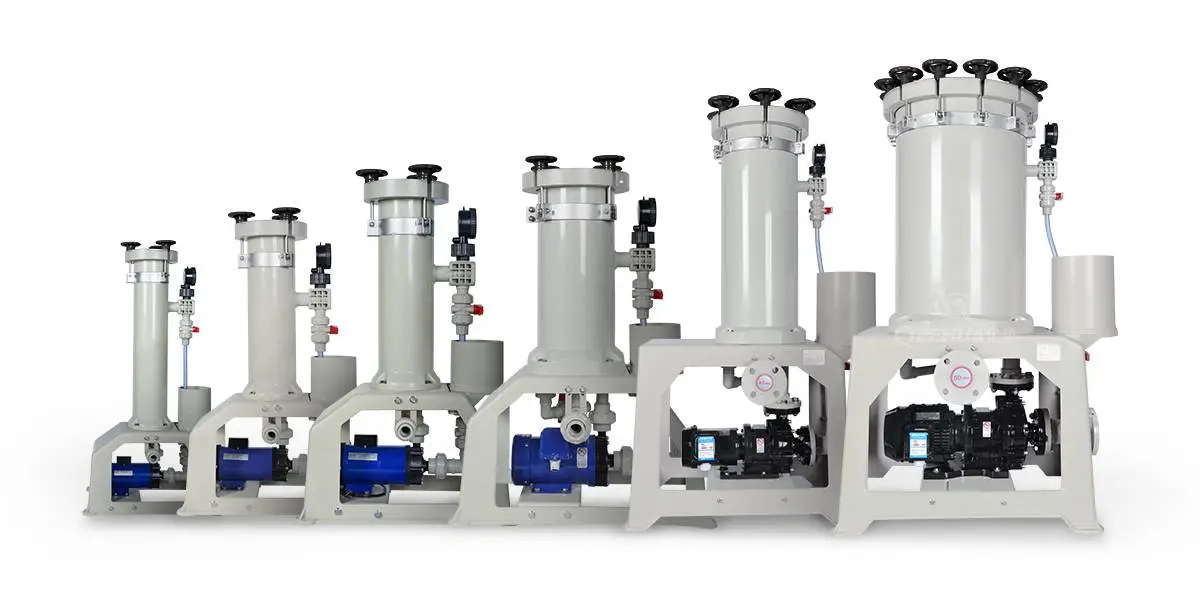
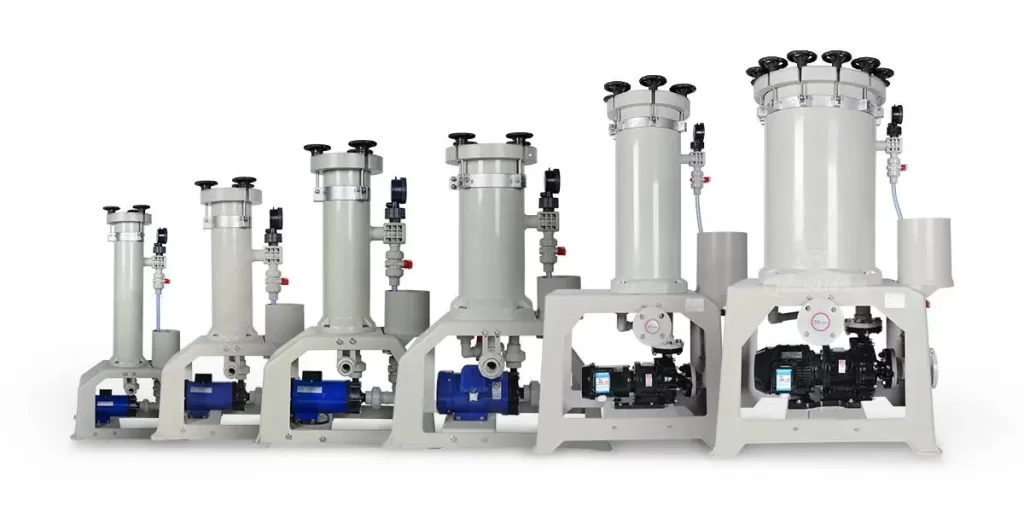
For filter hardware, review corrosion resistance, cartridge quantity, drain design, vent location, O-ring material, and whether cartridge, bag, or disc paper filtration is best for the contamination type. QEEHUA’s QH series precision chemical filter is relevant when the line needs corrosion-resistant chemical filtration with cartridge or other media options.
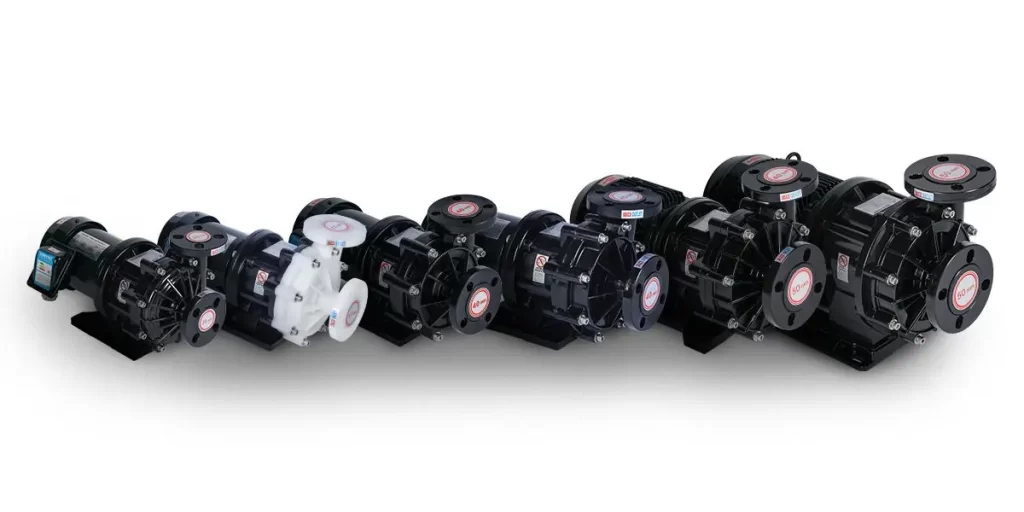
For the pump, prioritize wetted material compatibility, smooth internal surfaces, stable flow, low leakage risk, and protection against dry running or overload. QEEHUA’s QHX magnetic pump series can be reviewed for clean corrosive circulation where a sealless structure and suitable plastic or fluoroplastic materials fit the chemistry. However, magnetic drive pumps should not be used as a shortcut for dirty liquids containing hard solids or magnetic metal particles. If the bath carries abrasive particles, high solids, or frequent plate-out flakes, upstream filtration, tank cleaning, and pump clearances must be engineered before the pump is selected.
Maintenance Prevention SOP
A good electroless nickel maintenance routine keeps deposits from becoming hard scale. The SOP should include clean cartridge handling, complete filter venting after every cartridge change, scheduled drain and rinse steps after shutdown, passivation or stripping procedures when required by the bath supplier, and inspection of dead legs where liquid can cool and crystallize.
QEEHUA’s local pain-point files repeatedly show the same practical failures across PCB and electroplating lines: low-position vent valves that cannot remove air, missing drain valves, filter covers that leak because the housing is not level, pump flow that exceeds filter rating, clogged pressure gauge diaphragms, and residual liquid left in the filter after shutdown. These are not small details. In electroless nickel service, each one can seed plate-out or hide a developing restriction until the line loses flow.
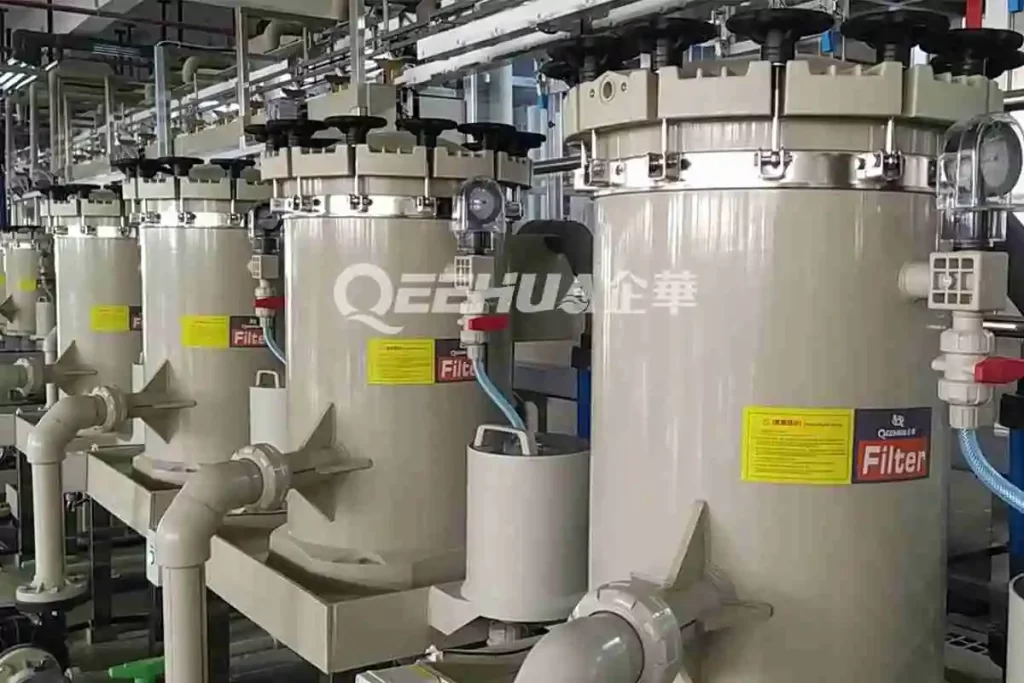
For new installations, add a pressure gauge or differential pressure method that operators actually read, keep the suction pipe at least as large as the pump inlet, reduce elbows and dead legs, install the vent at a high point, use a bottom drain, and label the flow direction. For existing lines, compare clean-cartridge pressure after every maintenance cycle. A rising clean baseline usually means the pipe, pump, or housing is accumulating deposits.
For a related troubleshooting angle, review How Plating Rectifier Works in Plating Process: A Complete Guide before finalizing the pump decision.
FAQ
Why does an electroless nickel pump clog so quickly?
Fast clogging usually means the bath is generating particles, plate-out, or crystals faster than the filter can remove them. Check bath stability, pH, temperature, contamination, passivation, cartridge loading, suction conditions, and whether the filter is bypassing.
Is PVDF always the best pump material for chemical nickel?
No. PVDF is often useful because it has good acid resistance and a smoother wetted surface than many general-purpose plastics, but material choice must follow the actual chemistry, temperature, cleaning method, oxidizer content, and supplier compatibility limits.
Can a magnetic drive pump be used for electroless nickel?
It can be considered when the liquid is clean enough, the material is compatible, and the system is protected from dry running, solids, and plate-out flakes. For unstable or particle-heavy baths, the pump manufacturer and chemistry supplier should review the application before selection.
What filter precision should I use for chemical nickel?
There is no universal number. Many electroless nickel baths need fine continuous filtration, but the correct micron rating depends on bath chemistry, defect target, turnover rate, cartridge life, and contamination source. Follow the bath supplier’s technical data and verify with actual pressure and defect records.
What is the fastest field check for repeated clogging?
Inspect the removed cartridge and pump cavity. If you find nickel film, hard crystals, or metal flakes, treat the problem as a bath stability and system cleanliness issue, not only a cartridge replacement issue.
Conclusion
Electroless nickel plating pump clogging is a system problem. The best fix combines bath control, compatible materials, correct pump-filter matching, full venting, reliable drainage, clean maintenance, and regular inspection of deposits before they harden. If material compatibility is uncertain, compare the actual chemistry against QEEHUA’s corrosion-resistant chemical pump material selection guide before approving the pump, filter, O-rings, valves, and piping.
For chemical nickel, chemical gold, PCB surface finishing, or electroplating pump-filter selection, share the liquid name, concentration, temperature, tank volume, target filtration precision, flow/head requirement, and failure symptoms with QEEHUA. Email QEEHUA at info@qeehua.com for an application-specific review.
