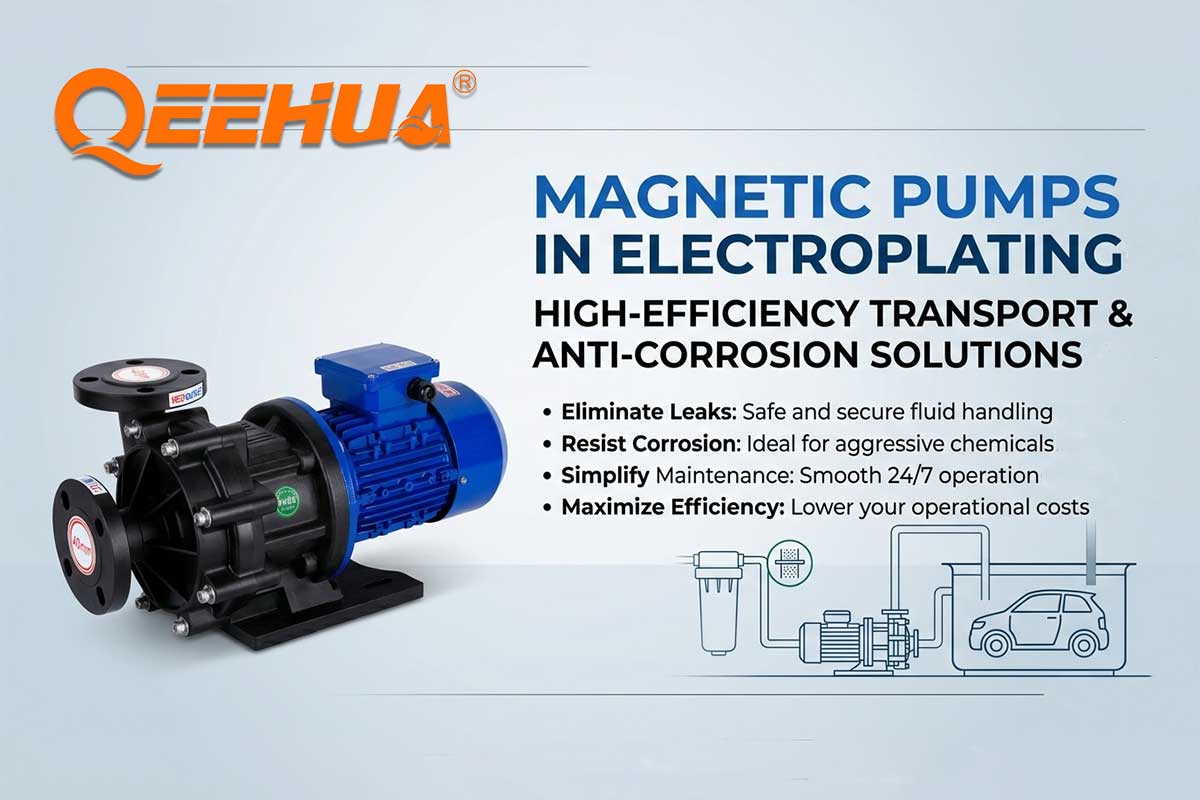
In the world of industrial fluid handling, magnetic pumps have revolutionized how we manage corrosive, hazardous, and high-purity liquids. As a sealless alternative to traditional mechanical seal pumps, magnetic drive pumps eliminate leakage risks, reduce maintenance costs, and enhance safety in demanding environments like chemical processing, pharmaceuticals, and wastewater treatment. If you’re a distributor looking to source reliable magnetic pumps from a trusted manufacturer, this comprehensive guide will walk you through everything you need to know—from the basics of magnetic pump technology to selecting the right manufacturer and why Qeehua Pump’s QHX series is a game-changer.
- Get your chemical pump solution now
- Engineers will provide model selection and quotation within 24 hour
This article draws inspiration from popular resources on magnetic pumps (like those from industry leaders such as March Pump and Iwaki), but we’ve expanded it significantly with in-depth technical insights, real-world applications, comparison charts, and a focus on distributor benefits. At over 2,500 words, it’s designed to be your go-to resource for understanding and sourcing magnetic pumps.
What Are Magnetic Pumps and How Do They Work?
Magnetic pumps, often called mag-drive pumps or sealless centrifugal pumps, use magnetic coupling to transfer torque from the motor to the impeller without a physical shaft seal. This design prevents leaks, which is critical when handling aggressive chemicals like acids, alkalis, or solvents.
Key Components:
- Outer Magnetic Rotor: Attached to the motor shaft, it rotates and creates a magnetic field.
- Inner Magnetic Rotor: Connected to the impeller inside the pump housing.
- Isolation Sleeve (Containment Shell): A non-magnetic barrier that separates the wet end (fluid side) from the dry end (motor side), ensuring no contact between the fluid and the atmosphere.
- Impeller and Housing: Made from corrosion-resistant materials to withstand harsh fluids.
Unlike traditional pumps with mechanical seals that wear out and leak over time, magnetic pumps rely on passive magnets for power transmission. This results in zero emissions, making them compliant with strict environmental regulations like those from the EPA or EU REACH.
Advantages Over Sealed Pumps:
- Leak-Proof Operation: No seals mean no leaks, reducing downtime and environmental hazards.
- Lower Maintenance: Fewer parts to replace; no seal flushing required.
- Energy Efficiency: Optimized flow paths can achieve up to 80% efficiency.
- Safety: Ideal for volatile or toxic fluids, as there’s no risk of seal failure exposing operators.
However, magnetic pumps aren’t without challenges. They can be prone to dry-running damage if not monitored, and decoupling (when magnets slip) can occur under high loads. Modern designs, like those with intelligent protection systems, mitigate these issues.
Types of Magnetic Pumps
Magnetic pumps come in various configurations to suit different applications:
Centrifugal Magnetic Pumps: The most common type, using centrifugal force for high-flow, low-pressure scenarios. Flows can range from 1 L/min to over 1,000 L/min.
- Centrifugal Magnetic Pumps: The most common type, using centrifugal force for high-flow, low-pressure scenarios. Flows can range from 1 L/min to over 1,000 L/min.
- Positive Displacement Magnetic Pumps: For viscous fluids or precise metering, like gear or vane pumps with mag-drive.
- Self-Priming Magnetic Pumps: Handle suction lifts without priming, useful in variable-level tanks.
- High-Temperature/High-Pressure Variants: Designed for extreme conditions, with reinforced materials.
In the petrochemical industry, centrifugal types dominate due to their reliability in continuous operations.
Applications of Magnetic Pumps in Key Industries
Magnetic pumps shine in sectors where fluid integrity and safety are paramount:
- Chemical Processing: Transferring acids (e.g., sulfuric, hydrochloric) and bases without corrosion or leaks.
- Pharmaceuticals and Biotechnology: Handling sterile or high-purity fluids in cleanrooms.
- Semiconductor Manufacturing: Circulating etchants and slurries in PCB production.
- Plating and Surface Treatment: Pumping electroplating solutions like chrome or nickel baths.
- Wastewater Treatment: Managing corrosive effluents in environmental plants.
- Photovoltaics and Solar: Circulating chemicals in panel production.
- Oil and Gas: Though less common, used for secondary processes like chemical injection.
For distributors, focusing on versatile pumps like those for chemical wastewater or plating opens up multiple market segments.
Top Magnetic Pumps Manufacturers: A Comparative Overview
The global magnetic pumps market is projected to grow at a CAGR of 6.5% through 2030, driven by industrialization in Asia and stricter safety norms. Here’s a roundup of leading manufacturers, based on market share, innovation, and reliability (sourced from industry reports like those on Metoree and Teffiko):
| Manufacturer | Headquarters | Key Strengths | Popular Models | Price Range (USD) | Limitations |
|---|---|---|---|---|---|
| March Pump | USA | Pioneer in sealless designs; wide OEM applications | TE-5C-MD, AC-5C-MD | 200-2,000 | Limited high-flow options |
| Iwaki America | USA/Japan | High-efficiency mag-drive; chemical focus | MDM Series, MX Series | 300-5,000 | Higher cost for customizations |
| Sundyne (HMD Kontro) | USA/UK | Heavy-duty for petrochemicals; first mag-drive inventor | GSA/GSI Series | 1,000-10,000 | Complex for small-scale use |
| Klaus Union | Germany | Extreme-duty pumps; over 60,000 installations | SLM-NVO (up to 18,000 GPM) | 5,000+ | Premium pricing |
| Flowserve | USA | Comprehensive process pumps | Innomag Series | 2,000-15,000 | Less focus on small distributors |
| Qeehua Pump | China | Affordable, corrosion-resistant; innovative QHX series | QHX-440, QHX-650 | 500-3,000 | Emerging global presence |
| Richter (IDEX) | Germany | Lined pumps for corrosives | RMI Series | 1,500-8,000 | Specialized, not broad range |
| Blackmer (PSG) | USA | Sliding vane mag-drive for viscous fluids | MAGNES Series | 2,000-6,000 | Not ideal for low-viscosity |
| Optimex | France | API-compliant for oil/gas | OPTIMAG Series | 3,000+ | Limited availability in Asia |
| Ruhrpumpen | Germany/Mexico | Cost-effective sealless | CRP-M Series | 1,000-5,000 | Fewer material options |
This table highlights how established players like Sundyne and Klaus Union excel in high-end markets, but emerging manufacturers like Qeehua offer competitive pricing without sacrificing quality—perfect for distributors targeting cost-sensitive regions.
How to Choose the Right Magnetic Pumps Manufacturer
Selecting a manufacturer involves more than specs; consider these factors:
- Material Compatibility: Ensure options like PVDF or ETFE for strong acids, or PP for weaker ones. Temperature resistance (up to 120°C) is key.
- Performance Specs: Match flow (L/min), head (m), and power (kW) to your application. Look for low NPSHr to prevent cavitation.
- Certifications: ISO 9001, CE, ATEX for hazardous areas.
- Supply Chain and Support: Global shipping, quick lead times (under 4 weeks), and technical training.
- Distributor Programs: Exclusive territories, marketing materials, and priority service.
- Innovation: Features like dry-run protection or low-vibration designs.
- Cost vs. Value: Balance upfront price with lifecycle costs—sealless pumps save on seals (up to $500/year per pump).
For distributors, partnering with a manufacturer that offers flexible terms can boost margins by 20-30%.
Spotlight on Qeehua Pump: A Rising Star in Magnetic Pumps Manufacturing
As a China-based manufacturer with over a decade of expertise, Qeehua Pump specializes in chemical pumps for global markets. Registered in 70+ countries and holding ISO 9001 and CE certifications, Qeehua focuses on R&D and in-house production for consistent quality. Unlike many competitors, Qeehua doesn’t sell directly to end-users—instead, it empowers distributors with competitive tools.
Introducing the QHX Series: Engineered for Excellence
The QHX series represents Qeehua’s flagship magnetic centrifugal pumps, designed specifically for harsh chemical environments. Building on standard mag-drive tech, QHX incorporates advanced features that address common pain points in existing models (e.g., from March or Iwaki).
Key Features of QHX Magnetic Pumps:
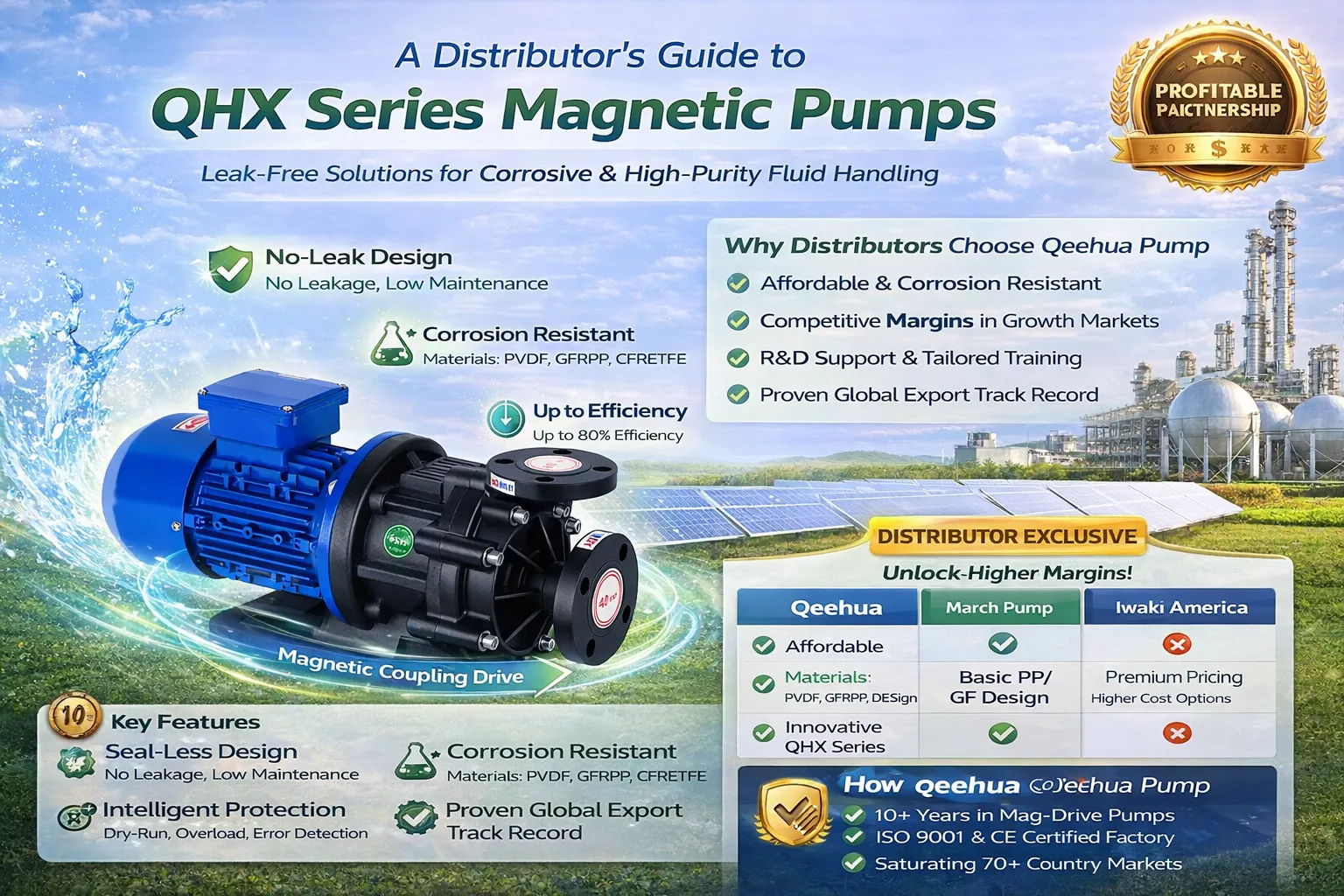
- Leak-Free Design: No mechanical seals; uses magnetic actuators with outer/inner rotors and a non-magnetic isolation sleeve for static sealing.
- Efficiency Boost: New runner design minimizes flow losses, achieving up to 80% efficiency—10% better than many legacy models.
- Intelligent Protection: Optional device prevents dry-running, overload, phase loss, and operator errors, extending pump life by 50%.
- Low Deflection and Vibration: Impeller deflection <0.2mm; vibration <2.0mm/s after dynamic balancing.
- Enhanced Sealing: Convex point structure on covers with flat gaskets; SUS304 back cover gaskets for superior pressure resistance.
- Magnet Integrity: Passive magnets injection-molded with plastic shells to prevent penetration; resin-coated drive magnets for corrosion resistance.
- Shaft Durability: 99% alumina or SSIC cores for wear resistance.
Specifications:
- Flow and Head: 50Hz: Up to 1,101 L/min flow, 36m head; 60Hz: Up to 1,067 L/min, 37.6m head.
- Inlet/Outlet: 25x25mm to 65x65mm.
- Power Range: 0.37-4 kW.
- Models: Includes QHX-440 (compact for mid-flow) and larger variants like QHX-650 for high-capacity needs.
Material Options Tailored to Conditions:
- GFRPP: For weak acids/alkalis <70°C.
- CFRPP: Weak acids/alkalis <80°C.
- PVDF: Strong acids <100°C.
- CFRETFE: Strong acids/alkalis <120°C.
These materials outperform basic PP in competitors’ entry-level lines, offering broader chemical compatibility (e.g., handles HF or HNO3 better).
Applications Where QHX Excels:
- PCB and Semiconductors: Precise circulation of etchants without contamination.
- Plastic Plating: Reliable for chrome or zinc solutions, reducing plating defects.
- Photovoltaics: High-purity handling in solar cell production.
- Chemical Pharmaceuticals: Leak-free transfer of APIs and solvents.
- Wastewater Treatment: Corrosion-resistant for acidic effluents.
Compared to Sundyne’s HMD series (great for oil/gas but overkill for general chemicals), QHX provides similar reliability at 30-50% lower cost, making it ideal for distributors in emerging markets like Southeast Asia or Latin America.
Real-World Case Study: A European plating distributor switched to QHX pumps, reporting 40% reduced maintenance and zero leaks over 18 months, boosting client satisfaction.
 Why Partner with Qeehua as a Distributor?
Qeehua’s distributor program is designed for mutual growth. As outlined on their distributors page, they offer:
- Partnership Tiers: Non-exclusive distributors, exclusive country/regional agents, or global partners.
- Benefits: Competitive pricing, fast delivery (priority for partners), free marketing materials (catalogs, videos), and technical training on assembly/maintenance.
- Support: Dedicated export team, social media promotion, and R&D access for custom needs.
- Global Reach: Strong presence in 70+ countries, with a focus on empowering partners rather than competing.
To get started, visit Qeehua’s distributors page and fill out the questionnaire. Their CEO is open to direct discussions for tailored agreements.
MANUFACTURER+TRADER EXPERT OF CHEMICAL FLUID EQUIPMENT
We not only offer high-performance chemical pumps, but also integrate upstream and downstream resources such as valves, pipelines, and control systems. We create integrated solutions that match the scenarios for industries like PCB, electroplating, and chemical engineering. Submit your requirements and we will tailor the best configuration for you.

Common Challenges and Solutions in Magnetic Pump Usage
- Dry-Running: Solution: QHX’s intelligent protector monitors and shuts down automatically.
- Decoupling: Use proper sizing; Qeehua provides free selection tools.
- Corrosion: Match materials to fluids—Qeehua’s PVDF/CFRETFE options handle 90% of chemicals.
- Installation Tips: Ensure flooded suction; align magnets properly for smooth startup.
Maintenance is minimal: Annual inspections of magnets and bearings suffice.
Future Trends in Magnetic Pumps
The industry is shifting toward smart pumps with IoT integration for predictive maintenance. Sustainable materials (recycled composites) and energy-efficient designs will dominate. Qeehua is investing in these, with new eco-friendly models slated for 2027.
Conclusion: Elevate Your Distribution Business with Qeehua’s QHX Series
In a crowded market, Qeehua Pump stands out as a magnetic pumps manufacturer that combines innovation, affordability, and distributor-centric support. The QHX series isn’t just a product—it’s a solution for leak-free, efficient chemical handling that outperforms many established brands in value. If you’re a global distributor ready to expand your portfolio, head to Qeehua’s distributors page to explore partnerships. Contact them today and build a taller “skyscraper” in your sourcing strategy.