

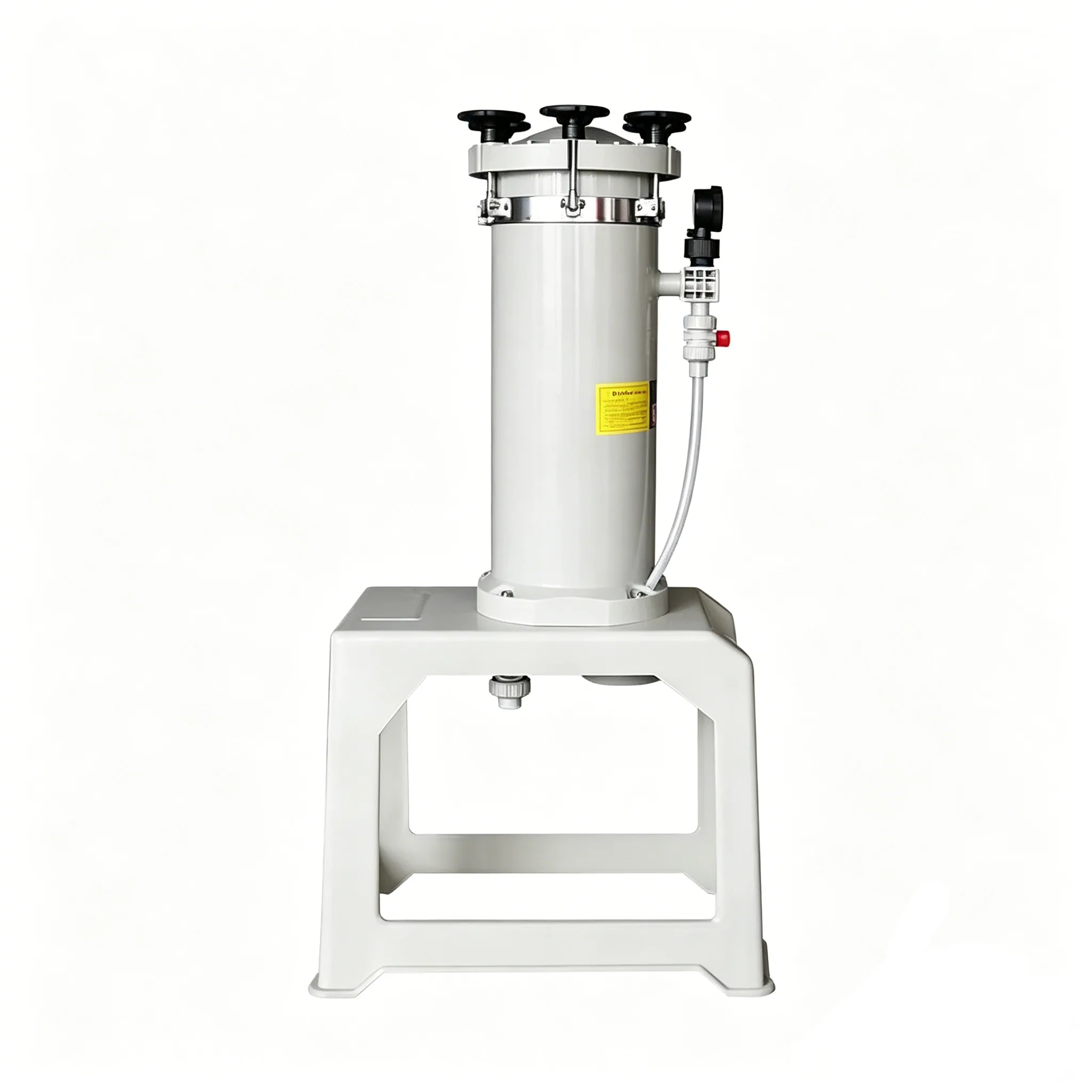
If a PCB chemical filter still lets particles, residue, or bath debris return to the tank, the problem is often not the nominal micron rating alone. In many wet-process lines the real cause is filter short circuit: liquid finds a path around the cartridge, bag, disc, carbon layer, or sealing surface and returns to the bath without being fully filtered. The most common causes are reversed inlet and outlet piping, missing or twisted O-rings, loose cartridge compression, leaking bypass valves, trapped air, damaged cartridges, and pump flow that exceeds the filter’s rated capacity.
This troubleshooting guide is written for PCB developing, etching, stripping, chemical copper, chemical nickel, chemical gold, solder mask, and electroplating circulation loops. It combines QEEHUA local application knowledge with current WordPress site research on chemical filters, QH precision chemical filters, QL chemical filters, and QHX magnetic drive pumps.
What Filter Short Circuit Means in a PCB Chemical Loop
Filter short circuit means that part of the process liquid bypasses the intended filtration path. The pump may be running, the pressure gauge may show pressure, and the return line may look active, but a portion of the bath is not forced through the filter media. In practical terms, unfiltered liquid can carry copper particles, resist fragments, solder mask residue, crystallized salts, carbon fines, rust dust, fibers, or process sludge back to the tank.
For PCB production, this is more serious than a general housekeeping issue. Fine-line boards, high-density interconnect panels, microvias, and gold or nickel finishes are sensitive to small particles. A filtration bypass can show up as residual glue after developing, particles on copper surfaces, scratches, pinholes, rough plating, hole-wall defects, weak bonding, short circuits, or local over-etch and under-etch symptoms.

Symptoms That Point to Bypass Instead of a Simple Dirty Cartridge
A blocked cartridge normally causes a rising pressure differential and declining flow. A short-circuiting filter behaves differently. The line may have acceptable flow, but the bath does not get cleaner. Engineers should suspect bypass when the filter was recently serviced, the pressure reading looks normal, yet particle problems continue.
- Particle count or visual contamination remains high after cartridge replacement.
- Pressure is lower than expected even with a new filter element installed.
- Pressure is normal, but downstream bath clarity does not improve.
- Residue defects appear soon after maintenance work on the filter housing.
- Air bubbles keep returning from the outlet, especially after start-up.
- Different tanks show similar contamination after using a shared filter cart or shared piping.
- Fine filter cartridges fail early, collapse, or tear after a high-flow pump is installed.
The Main Causes of PCB Filter Short Circuit
| Cause | What happens in the loop | Likely PCB consequence | Corrective action |
|---|---|---|---|
| Inlet and outlet are reversed | Liquid enters the housing from the wrong side and avoids the designed media path. | Particles return to the bath even though the pump is running. | Confirm flow arrows, port labels, and test direction before production start-up. |
| O-ring missing, twisted, cut, or chemically swollen | Liquid leaks around the seal instead of through the cartridge. | Intermittent particles, leakage around the cover, unstable pressure. | Replace with a chemically compatible seal and seat it cleanly without twisting. |
| Center rod or cartridge compression is loose | Cartridges lift or float, opening a bypass gap. | High particle return after cartridge change. | Lock the center rod, compression plate, and spring seat to the specified fit. |
| Bypass valve leaks internally | Unfiltered liquid quietly returns to the tank through the bypass branch. | Bath clarity does not improve even with clean cartridges. | Use sealing-type chemical valves, tag the bypass position, and test for internal leakage. |
| Air is trapped in the housing | Cartridge area is partly air-filled, reducing effective filtration area. | Flow swings, gas binding, foam, local process instability. | Put the vent at the highest point and vent until no bubbles discharge. |
| Pump flow exceeds filter rating | The cartridge is overloaded or damaged by excessive velocity and pressure. | Cartridge rupture, poor capture efficiency, particles after the filter. | Match pump flow to filter capacity; use a control valve or variable frequency drive where appropriate. |
| Filter precision is wrong for the bath | Particles smaller than the selected media pass through normally. | Residual glue, rough copper, poor hole metallization, gold layer defects. | Select precision by process sensitivity, contaminant type, and cartridge life. |
A 20-Minute Field Diagnostic Sequence
When a filter loop is suspected of short-circuiting, avoid replacing parts randomly. A short structured check usually finds the root cause faster.
1. Confirm the flow path before opening the housing
Trace the pump outlet, filter inlet, filter outlet, return line, drain, vent, bypass branch, and sampling point. Many short-circuit problems come from installation details: a reversed connection, an open flushing branch, a bypass valve that looks closed but leaks, or a shared return line without a check valve.
2. Compare inlet pressure, outlet pressure, and actual flow
A healthy filter loop should show a pressure pattern that makes sense for the cartridge age, bath viscosity, pipe length, and pump curve. A very low differential pressure with dirty liquid can indicate bypass. A very high differential pressure can indicate blocked cartridges, closed valves, undersized piping, or a pump that is too large for the housing.
3. Vent the housing completely
Air binding is common after cartridge replacement, drain-down, tank changeover, or suction-side leakage. Vent from the top of the filter housing until the discharge is liquid without bubbles. If air returns repeatedly, inspect the suction pipe slope, pump suction level, loose fittings, vortexing near the tank outlet, and low-liquid-level operation.

4. Open the housing and inspect sealing surfaces
After isolating, depressurizing, draining, and following site safety procedures, check the O-ring groove, upper cover, cartridge seats, center rod, spring, compression plate, and bottom locator. Look for scratches, hard chemical crystals, swollen elastomer, chipped PP or PVDF parts, and fibers trapped on the sealing face. Even a small foreign object under an O-ring can create a bypass channel.
5. Inspect the cartridge or media
If the cartridge is crushed, torn, floating, or heavily loaded on only one side, the problem may be uneven compression, excessive pump flow, air pockets, or a dirty upstream tank rather than cartridge quality alone. For developing, solder mask, chemical copper, and chemical gold, clean handling is critical because dust, hair, rust particles, and fabric fibers can create board defects.
How to Prevent Filter Bypass in New PCB Lines
The best time to prevent short circuit is before commissioning. Treat the filter, pump, valves, piping, and operating SOP as one circulation loop.
- Use clear flow-direction labels on the filter housing, pump outlet, return line, and bypass branch.
- Install the filter level, with venting at the highest practical point and drainage at the lowest practical point.
- Use clean, chemically compatible O-rings and inspect the groove every time the housing is opened.
- Match the pump curve to filter rated flow, bath turnover target, pipe resistance, and cartridge type.
- Use a pressure gauge or differential pressure method so operators know when cartridges are loaded.
- For shared filtration, use isolation valves, check valves, flushing steps, and clear tank identification.
- Keep a dedicated maintenance kit for clean PCB work: gloves, lint-free wipes, clean tools, spare O-rings, and cartridge caps.
Choosing the Right QEEHUA Filter and Pump Combination
QEEHUA’s chemical filter range includes multiple filter families used for PCB, electroplating, chemical plating, surface treatment, and related corrosive liquid processes. Selection should start from the liquid, concentration, temperature, solids, required cleanliness, and process risk.
QH chemical filters are relevant when a plant needs high-precision filtration with corrosion-resistant materials such as PP or PVDF, depending on the process conditions. QL chemical filters can be considered for larger circulation or chemical filter installations where the filter capacity and cartridge arrangement must match the bath turnover. QHC chemical filters are another option to review when equipment layout, chemical compatibility, and filter media style make them a better mechanical fit.
The pump must be selected with the filter, not after it. A QHX plastic magnetic drive pump is a strong fit for many PCB chemical circulation loops where leakage reduction, corrosion resistance, and clean transfer are important. However, magnetic pumps should not be used as a shortcut for dirty liquids containing hard solids or magnetic metal particles unless the upstream filtration, tank cleaning, and material selection are properly engineered. Where low-liquid-level risk is high, dry-run and overload protection should also be reviewed; QEEHUA’s pump protection device page is relevant for this part of the system discussion.

Material Selection Notes for Bypass-Sensitive Baths
Material choice also affects filtration reliability. PPH or PP can be suitable for many ordinary acid and alkali solutions at moderate temperatures. PVDF is often preferred where stronger acid resistance, smoother wetted surfaces, or higher cleanliness is needed, including chemical nickel, chemical gold, and crystallization-prone liquids. FEP, PFA, or PTFE designs may be required for demanding strong acid or alkali service, broad corrosion resistance, or lower liquid adhesion. Stainless steel should only be used where the liquid chemistry is compatible, such as selected alkaline or higher-temperature services; it is not automatically suitable for acid or chloride-bearing PCB chemicals.
Elastomers matter as much as the housing material. EPDM is often used for many alkaline and ordinary acid conditions, while FKM may suit many acidic liquids and some solvents but is usually not the first choice for alkaline service. Do not generalize from material name alone. Confirm liquid composition, concentration, operating temperature, cleaning chemistry, and whether the bath contains oxidizers, fluoride, chloride, abrasives, or metal fines.
Maintenance SOP for Stable Filtration
- Stop the pump, isolate the filter, release pressure, and drain the housing safely.
- Remove the cover without scratching the sealing surface.
- Inspect O-rings, center rod, compression plate, cartridges, and bottom seats.
- Clean crystal deposits and sludge with compatible tools and approved plant procedures.
- Install new cartridges with clean gloves and keep packaging closed until use.
- Confirm the bypass valve is closed and tagged before restarting.
- Fill slowly, vent completely, and start the pump only after the loop is liquid-filled.
- Record start-up pressure, differential pressure, flow, date, cartridge type, and operator.

FAQ
Can a PCB chemical filter have normal pressure but still bypass particles?
Yes. Normal pressure does not prove that all liquid is passing through the filter media. A leaking O-ring, floating cartridge, reversed port, open bypass valve, or internal valve leak can let particles return to the bath while the gauge still shows pressure.
What is the fastest way to confirm filter short circuit?
Check flow direction, bypass valve position, venting, differential pressure, and cartridge seating. If the bath stays dirty after new cartridges and the pressure pattern is abnormal, inspect the O-ring groove, center rod, compression plate, and cartridge seals.
Why does air binding reduce filtration performance?
Air trapped in the housing reduces the wetted filtration area and can interrupt cartridge contact. It also causes unstable flow, bubbles, foam, and pump suction problems. The vent should be at the highest point and used until liquid flows without bubbles.
Should I simply choose a finer micron cartridge?
Not always. If the filter is bypassing, a finer cartridge will not solve the root cause. First prove that all liquid is forced through the media. Then choose filter precision based on the process, particle type, bath turnover, cartridge life, and acceptable pressure drop.
How should pump flow be matched to a chemical filter?
Pump flow should stay within the filter housing and cartridge rating while meeting bath turnover requirements. Excessive flow can tear cartridges, reduce capture efficiency, raise pressure, or open weak sealing points. Use the pump curve, pipe loss, valve setting, and filter capacity together.
When should a PCB line use a dedicated filter instead of sharing one filter between tanks?
Dedicated filtration is preferred when cross-contamination risk is high, such as chemical gold, chemical copper, developing, solder mask, and other sensitive baths. If sharing is unavoidable, use check valves, isolation valves, flushing procedures, and strict tank labeling.
Conclusion
PCB filter short circuit is a system problem. The filter element, housing seal, pump flow, vent location, bypass piping, valve condition, and maintenance cleanliness all decide whether particles are actually removed. When a PCB wet-process bath remains dirty after cartridge replacement, do not stop at the micron rating. Prove the flow path, seal every bypass route, vent the housing, match the pump to the filter, and document the operating pressure after each service.
For new or upgraded PCB filtration loops, QEEHUA can help review the chemical liquid, concentration, temperature, flow, head, filter precision, material compatibility, and maintenance access before selecting a chemical filter and corrosion-resistant pump combination. Email QEEHUA for a filtration review.
