


A shared electroplating filter system can serve more than one PCB or plating tank only when the liquids are compatible, the piping has positive isolation, and the filter can be drained and flushed before the next tank is connected. If developer, etching, stripping, electroless nickel, chemical gold, or other sensitive baths share one filter without check valves and a verified flushing procedure, cross-contamination can quickly become a yield, corrosion, and maintenance problem. For the broader filter-and-pump selection logic behind this issue, see QEEHUA’s PCB wet process filtration guide.
This question matters to B2B buyers, equipment OEMs, maintenance teams, and plant managers because a shared filter often looks attractive on the layout drawing. It can reduce equipment count and save floor space. In production, however, the real cost is decided by retained liquid volume, valve discipline, bath sensitivity, and whether the first boards after a tank change remain within quality limits.

Why Cross-Contamination Happens
Cross-contamination is not only caused by an operator connecting the wrong hose. It often starts with a small amount of retained solution inside the filter barrel, pump casing, inlet pipe, outlet manifold, pressure gauge branch, drain pocket, or dead leg. When the system is switched to a different tank, that retained solution can be pushed into the next bath.
In local QEEHUA application materials for electroplating and PCB workshops, repeated risk points appear: multi-tank shared filters without anti-backflow devices, no flushing line, no bypass, reverse connection of filter inlet and outlet, poor venting, dead zones in piping, and filter flow that does not match pump flow. These are not abstract design details. They can appear as residual glue, particle defects, metal-ion drift, uneven etching, poor deposition, or unexpected filter blockage.
The highest-risk cases usually combine three conditions: incompatible chemistry, high retained liquid volume, and no validated switching SOP. For example, a developer tank and an etching tank may both be part of the same PCB wet line, but that does not mean their filtration loops can be casually combined. Acid, alkali, oxidizer, reducing agent, metal salt, organic additive, and precious-metal bath behavior must be reviewed separately.
When a Shared Filter Is Acceptable
A shared electroplating filter is most defensible when the connected tanks use the same or very similar chemistry, operate at similar temperature and concentration, and have low sensitivity to trace carryover. Even then, the system should include isolation valves, check valves, high-point venting, low-point draining, and a written flush procedure with sample verification.
A shared filter is usually a poor choice when tanks contain different chemical families, when one bath is high value, or when the next process step is sensitive to trace contamination. Electroless nickel, chemical gold, fine-line PCB developer, stripping, and precision plating baths deserve special caution. If a few hundred milliliters of retained liquid can change pH, introduce metal ions, attack additives, or seed precipitation, the filter should normally be dedicated.
Design Controls for Shared Filtration
The safest architecture is one tank, one filter, and one dedicated circulation loop. Where a shared filter is unavoidable, the design should force the correct flow path. Each branch should have a corrosion-resistant isolation valve and a check valve, with clear flow-direction labels. The common manifold should be short, drainable, and free of upward pockets where liquid can sit after shutdown.
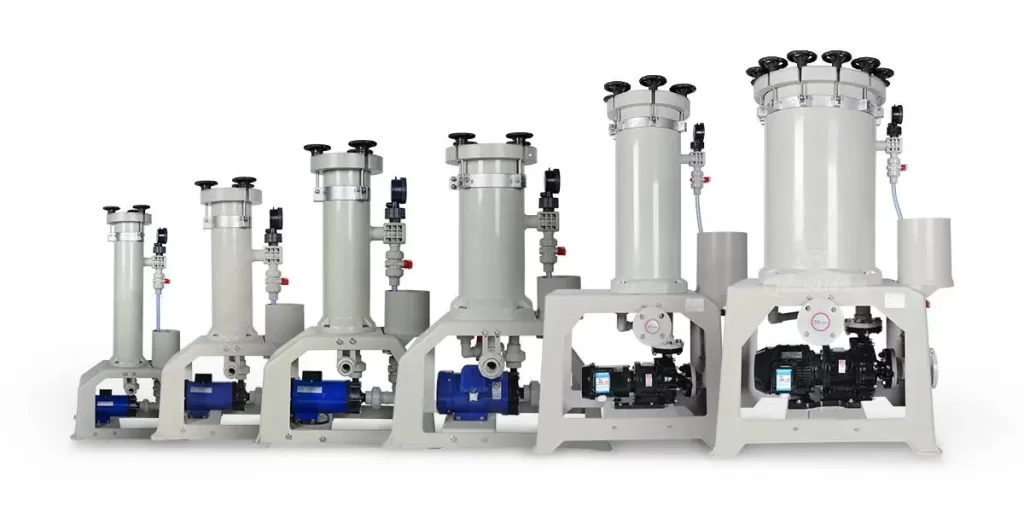
For corrosive plating lines, filter material and pump material must match both the strongest bath and the cleaning liquid used during flushing. QEEHUA chemical filter families such as the QH chemical filter are typically reviewed together with magnetic, vertical, or centrifugal pumps because filtration capacity, pump flow, pressure drop, and bath turnover are one system decision.
Flush design deserves the same attention as pump selection. A good shared-filter skid includes a clean flush source, a drain route to waste treatment, a way to isolate the production tank during flushing, and a simple verification point. For sensitive processes, conductivity, pH, color, or bath-specific test results should confirm that the previous liquid has been removed before the next tank is connected.
Controls and maintenance layout also matter. High-point vents help remove trapped air before filtration starts. Low-point drains reduce retained liquid. Differential pressure monitoring helps detect blocked cartridges. A bypass or standby filter can allow cartridge replacement without stopping a critical tank, but the bypass must not become another cross-contamination path.
Specification Checklist for Buyers and OEMs
When purchasing or designing a shared electroplating filtration system, ask the supplier to review the complete process sequence, not only the pump nameplate. The following checklist helps separate an acceptable shared loop from a risky shortcut.
| Design Point | Question to Ask | Practical Specification |
|---|---|---|
| Chemical compatibility | Are all connected baths compatible with the filter, pump, valves, seals, and flush liquid? | Confirm actual chemical name, concentration, temperature, metal content, oxidizer/reducer behavior, and elastomer selection. |
| Retained liquid volume | How much liquid remains in the filter barrel, pump casing, and manifold after draining? | Use low-point drains, short manifolds, and a documented flush volume based on real hold-up volume. |
| Backflow prevention | Can one tank push liquid backward into another branch? | Install corrosion-resistant check valves and isolation valves on every branch; verify direction during commissioning. |
| Flow and pressure balance | Does the pump flow match the filter capacity and cartridge pressure limit? | Avoid oversizing the pump against the filter. Use a control valve or bypass only if the bypass path is safe and labeled. |
| Venting and air removal | Can trapped air remain in the filter or high piping after tank switching? | Put vents and pressure gauges at high points; require venting before closing the filter and starting circulation. |
| Maintenance isolation | Can operators change cartridges without contaminating another tank? | Provide drain, flush, lockout, and waste-routing steps before the filter housing is opened. |
Filter integrity must also be checked. If particles still pass through after cartridge replacement, the issue may be a sealing path, wrong cartridge direction, loose center rod, damaged gasket, or flow bypass inside the housing. QEEHUA’s article on PCB chemical filter short circuit explains that failure mode in more detail.
Troubleshooting Signs After Tank Switching
Cross-contamination often appears after a maintenance event or tank change. The first warning may be a sudden bath color change, unstable pH, unusual foam, unexpected particles, faster cartridge blockage, abnormal pressure, or a defect pattern that appears only on the first production lots after filtration is restarted.
Maintenance teams should compare the timing of quality defects with filter switching records. If the same tank is stable on its own but produces defects after the shared filter is connected, inspect the manifold, check valves, flush path, drain points, and cartridge housing. Sampling the drain after the flush cycle can reveal whether the previous bath is still present.
For PCB lines, the consequences can be expensive: residue in developer, uneven etching, rough copper, pinholes, poor through-hole copper, plating haze, or micro-short risk. For electroplating lines, contamination can attack brighteners, change deposition behavior, or reduce bath life. These are process losses, not merely pump-room inconveniences.
A good corrective action starts with containment. Stop sharing the filter until the affected baths are isolated and tested. Drain and flush the filter and common manifold. Confirm valve direction. Replace swollen seals or damaged cartridges. Then decide whether the shared system can be redesigned or whether dedicated filtration is cheaper than repeated bath correction.
FAQ
Can one electroplating filter serve multiple tanks?
Yes, but only when the tanks use compatible chemistry and the system has proper isolation, check valves, draining, flushing, and verification. For sensitive PCB and plating baths, dedicated filtration is usually safer.
Do check valves fully prevent cross-contamination?
No. Check valves reduce backflow risk, but they do not remove liquid trapped in the filter, pump, or common manifold. Draining and flushing are still required.
Which PCB tanks should not share one filter?
Developer, etching, stripping, electroless nickel, chemical copper, chemical gold, and other sensitive or high-value baths should be reviewed very cautiously. Different acid, alkali, oxidizing, reducing, and metal-containing baths should not share a filter by default.
How long should the shared filter be flushed?
There is no universal time. The flush volume should be based on retained liquid volume in the filter, pump, and piping, then verified by pH, conductivity, color, or bath-specific testing before production restarts.
What information should I provide for pump and filter selection?
Share the bath name, concentration, temperature, tank volume, required turnover, filter precision, cartridge type, pipe length, valve sequence, whether tanks are shared, and photos or drawings of the current layout.
For new PCB wet-process lines or retrofit projects, QEEHUA can review whether a shared filter is acceptable or whether a dedicated filtration loop is the lower-risk option. You can also compare broader QEEHUA PCB fluid equipment solutions when planning pump, filter, and piping layouts.
