In industrial production, a pump is more than just a machine that moves liquid—it is the “heart” of the entire fluid system. Whether in chemicals, pharmaceuticals, semiconductors, electroplating, coatings, or new energy industries, the performance of a pump directly affects both stability and efficiency.
When handling corrosive or hazardous liquids, understanding the relationship between pressure and head is crucial. Choosing the right pump based on these factors ensures safe and efficient operation.
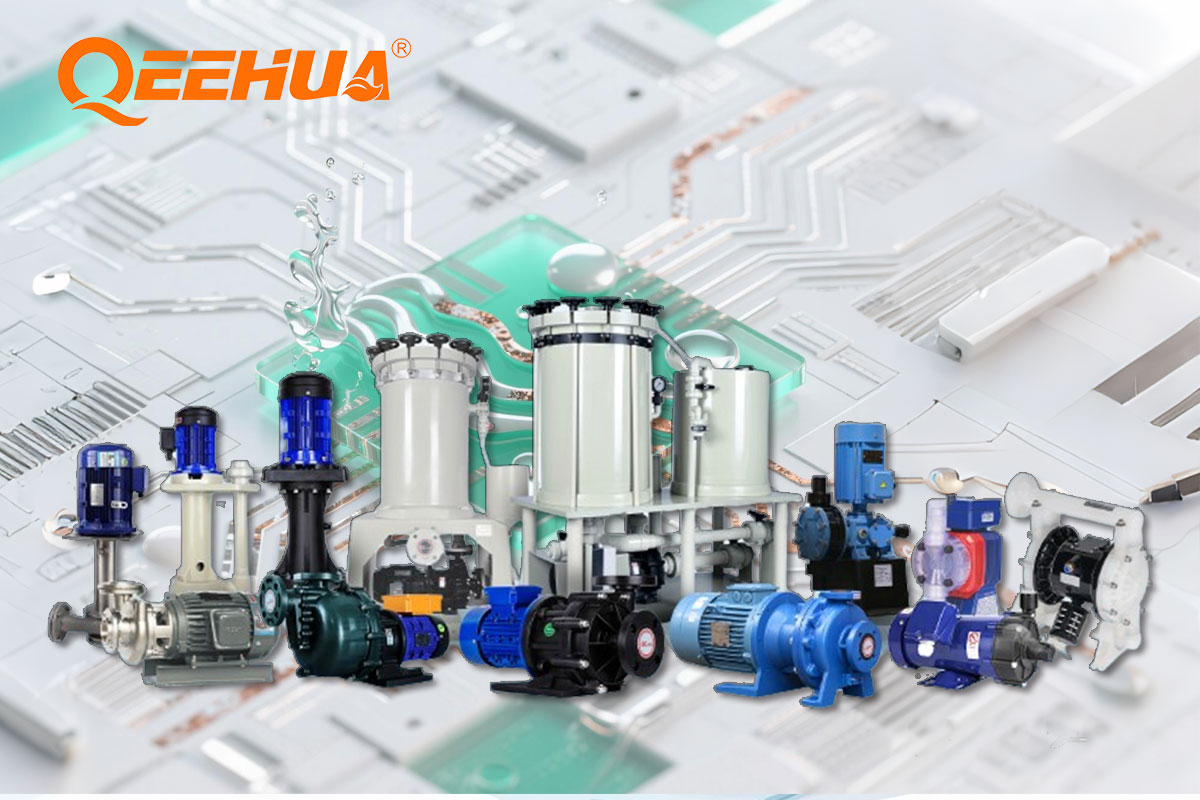
QEEHUA, a leading chemical pump manufacturer in China, specializes in magnetic drive pumps, mechanical seal centrifugal pumps, vertical pumps, and chemical filters. Its products are widely used in PCB, electroplating, pharmaceuticals, wastewater treatment, flow batteries, and solar energy.
This guide explains basic formulas, engineering calculations, and practical pump selection with examples from QEEHUA products.
Engineering note: This article explains pump pressure, pump head, and hydraulic selection for industrial liquid transfer systems. It is not a hydropower output-sizing guide for formulas such as P = rho g Q H eta. For chemical pump selection, use the formula section below to compare required head, system resistance, liquid density, and operating margin.
Related application note: If you want a live example of how pressure, flow resistance, and solids loading interact in a real circulation loop, see vanadium electrolyte precipitation and pump clogging. For filtration-side pressure rise in plating circulation, compare it with electroplating filter pressure too high.
- Get your chemical pump solution now
- Engineers will provide model selection and quotation within 24 hours
1. Basic Concepts of Pump Head and Pressure
Head (H)
Head measures the energy a pump gives to a liquid, expressed in meters of liquid column. It reflects the pump’s ability to overcome resistance and lift fluid.
Formula:
$$ H = \frac{p}{\rho g} + \frac{v^2}{2g} + z $$
Where:
-
H: Head (m)
-
p: Fluid pressure (Pa)
-
ρ: Fluid density (kg/m³)
-
g: Gravity (9.81 m/s²)
-
v: Fluid velocity (m/s)
-
zz: Height difference (m)
Thus, head depends on pressure, velocity, and height.
Pressure (p)
Pressure is the force acting on a liquid per unit area, measured in Pa, bar, or MPa. The link between head and pressure is:
p=ρgH
For example, with water((ρ = 1000 kg/m3) ) and a head of 10 m:
p=1000×9.81×10=98100Pa≈0.981bar
Key conversions:
-
1 bar ≈ 10.2 m of water head
-
1 m of water head ≈ 0.098 bar
2. Converting Head and Pressure: Examples
-
If a system requires 3 bar, the head needed is:
$$ H = \frac{p}{\rho g} = \frac{3 \times 10^5}{1000 \times 9.81} \approx 30.6 \, \text{m} $$
-
If a pump is rated at 40 m head, the pressure is:
So, a system needing 3 bar must select a pump with ≥ 31 m head.
3. Components of Total Head
The total head includes:
-
Static head (): height difference between inlet and outlet
-
Friction head (): losses in pipes
-
Local head (): losses from valves, bends, and filters
This means actual head can vary greatly depending on pipe layout.
4. QEEHUA Pump Advantages in Head and Pressure
Magnetic Drive Pumps
QEEHUA magnetic pumps use magnetic coupling instead of mechanical seals, preventing leakage. Ideal for:
-
Strong acids and bases (e.g., sulfuric acid, hydrochloric acid)
-
Toxic or hazardous chemicals
-
High-purity water in semiconductors and solar industries
Range: 5–60 m head (0.5–6 bar) → best for medium to low pressure and high sealing requirements.
Example: A magnetic pump with 25 m head handling sulfuric acid ($\rho = 1800$):
p=ρgH=1800×9.81×25≈441,450Pa≈4.41bar
Heavier liquids create more pressure at the same head.
Centrifugal Pumps
👉 View QEEHUA Centrifugal Pumps
Best for large flow and higher head applications:
-
Head up to 120 m (≈ 12 bar)
-
Handles clear liquids, particles, or cooling water
-
Used in coating, electroplating, and cooling systems
Example: A pump with 60 m head and 30 m³/h flow:
This makes it suitable for long pipelines or high-resistance networks.
MANUFACTURER+TRADER EXPERT OF CHEMICAL FLUID EQUIPMENT
We not only offer high-performance chemical pumps, but also integrate upstream and downstream resources such as valves, pipelines, and control systems. We create integrated solutions that match the scenarios for industries like PCB, electroplating, and chemical engineering. Submit your requirements and we will tailor the best configuration for you.

5. Relationship Between Head and Pump Efficiency
Pump performance depends on the balance between the pump curve and the system resistance curve.
If the head is too high, issues include:
-
Reduced flow
-
Efficiency drop
-
Higher energy use, noise, and vibration
Efficiency is calculated by:
$$ \eta = \frac{\rho g Q H}{P} $$
Where:
-
η: Efficiency
-
Q: Flow (m³/s)
-
H: Head (m)
-
P: Input power (W)
Example: Flow = 20 m³/h (≈0.00556 m³/s), head = 40 m, power = 3 kW:
$$ \eta = \frac{1000 \times 9.81 \times 0.00556 \times 40}{3000} \approx 0.73 $$
Efficiency ≈ 73%, within the optimal range.
6. QEEHUA’s Technical Strengths and Industry Value
QEEHUA offers innovations to maximize performance:
-
Magnet injection molding: prevents magnet cracking
-
Corrosion-resistant materials: extend pump life
-
Efficient hydraulic design: keeps pumps near peak efficiency
-
Smart selection service: provides calculation reports and solutions
These advantages allow QEEHUA to serve 10,000+ customers in 40+ countries.
7. Conclusion
Head and pressure are often confused, but they are different:
-
Head is the pump’s ability
-
Pressure is the effect on the liquid
They are linked by the formula:
p =
Key takeaways:
-
Magnetic pumps excel in corrosive and leak-sensitive applications
-
Centrifugal pumps fit large flow and higher head needs
-
Smart pump selection = correct conversion + system analysis + efficiency balance
With expertise in head and pressure control, QEEHUA ensures every pump runs safely, reliably, and efficiently in real-world conditions.