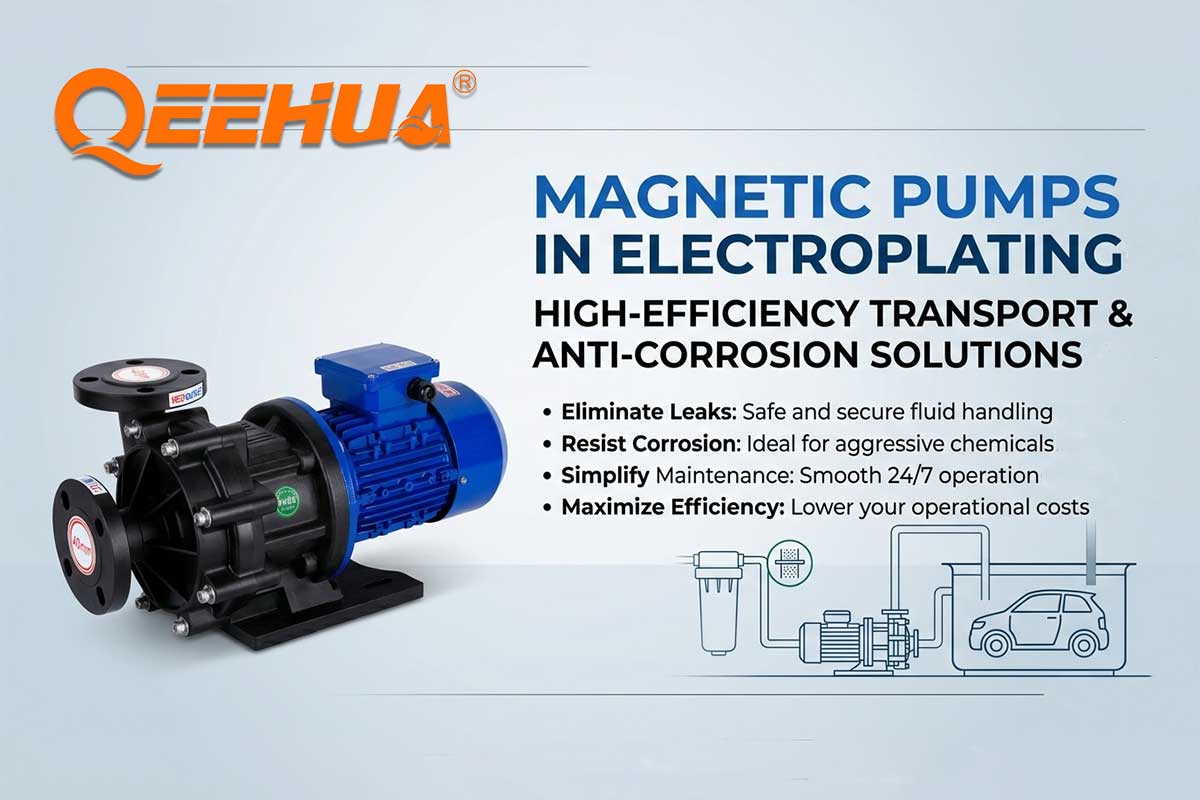
In industries such as chemical processing, pharmaceuticals, and water treatment, the safety and reliability of fluid transfer equipment are paramount. Traditional mechanical seal pumps often face challenges like leakage risks, high maintenance costs, and safety hazards. The emergence of magnetic drive pumps (Mag Drive Pumps) has revolutionized this landscape. Utilizing magnetic coupling to transmit power, these pumps achieve leak-free operation, offering exceptional corrosion resistance and safety, making them the preferred choice across various sectors.
1. Core Principle: The Leak-Free Technology of Magnetic Drive Pumps
At the heart of magnetic drive pumps lies their unique magnetic coupling system. Unlike traditional pumps that use mechanical seals to connect the drive shaft, magnetic drive pumps employ the interaction between inner and outer magnets to transmit power. The motor drives the external magnet, which, through a containment shell, synchronizes with the internal magnet connected to the impeller, propelling the fluid. This “contactless” transmission eliminates the possibility of shaft seal leakage, creating a completely sealed fluid environment.
The selection of containment shell materials, such as Hastelloy or ceramics, further enhances corrosion resistance, ensuring stable operation in high-temperature, high-pressure, and corrosive media environments.
2. Corrosion Resistance and Safety: The Guardian of the Chemical Industry
Chemical fluids often contain corrosive substances like acids, bases, and organic solvents. Traditional pumps with metal seals are prone to erosion, leading to leaks or equipment damage. Magnetic drive pumps address this issue through material optimization and innovative design. Pump bodies can be constructed from 316 stainless steel, titanium alloys, or engineering plastics like PTFE and PVDF, providing robust corrosion resistance. The containment shell and internal fluid-contacting components form a dual protection system.
3. Expanding Applications: From Laboratories to Industrial Scale
Magnetic drive pumps have permeated various fields:
-
Chemical Processing: Used to transfer highly corrosive acids, bases, salt solutions, and organic solvents.
-
Pharmaceutical Manufacturing: Ensures the purity and safety of drug production by preventing cross-contamination.
-
Semiconductor Industry: Maintains cleanliness during etchant transfer, crucial for chip manufacturing.
-
Electroplating Industry: Ensures process stability and uniformity of plating solutions, enhancing coating quality.
-
Food Processing: Leak-free and easy-to-clean designs prevent food contamination, ensuring hygiene and safety.
According to Verified Market Research, the global magnetic drive pump market was valued at USD 1.13 billion in 2023 and is projected to reach USD 1.95 billion by 2031, growing at a CAGR of 7.85% from 2024 to 2031.
4. Cost and Benefit: The Hidden Champion of Long-Term Value
Although the initial procurement cost of magnetic drive pumps is higher than traditional pumps, their lifecycle economic benefits are significant. For instance, in a petrochemical company:
-
Maintenance Costs: Traditional mechanical seal pumps incur annual maintenance costs of approximately $2,000 (for seal replacements and leak handling), whereas magnetic drive pumps require only about $500.
-
Environmental and Downtime Savings: Zero leakage reduces environmental fines and production losses, saving an average of $15,000 annually.
-
Energy Efficiency: Enhanced energy efficiency leads to a 12% reduction in power consumption.
Overall, the cost difference can be recouped within three years, with annual savings exceeding $17,000 thereafter.
QEEHUA: A Professional Leader in Chemical Fluid Equipment

QEEHUA: A Leader in China’s Magnetic Drive Pump Industry
As a renowned and trusted chemical pump brand in China, QEEHUA has dedicated over a decade to the research and development of magnetic drive pump technology. Its product range includes corrosion-resistant, high-temperature, and customized solutions, utilizing international standard 316L stainless steel and imported engineering plastics. The containment shell design complies with ANSI/ASME certifications, balancing performance and cost-effectiveness.
QEEHUA offers comprehensive services, from selection consultation and installation guidance to remote fault diagnosis, ensuring worry-free usage for customers. Notably, QEEHUA replaced imported magnetic drive pumps for North China Pharmaceutical, achieving stable transfer of -120°C low-temperature media, surpassing the performance of the original imported equipment.
Conclusion
With its leak-free design, exceptional corrosion resistance, and long-term economic benefits, magnetic drive pumps have become the “gold standard” in fields like chemical processing and pharmaceuticals. From precise laboratory operations to large-scale industrial projects, manufacturers like QEEHUA are reshaping the industry landscape with innovative technology. In today’s pursuit of efficiency and safety, magnetic drive pumps are undoubtedly a wise choice in fluid transfer.