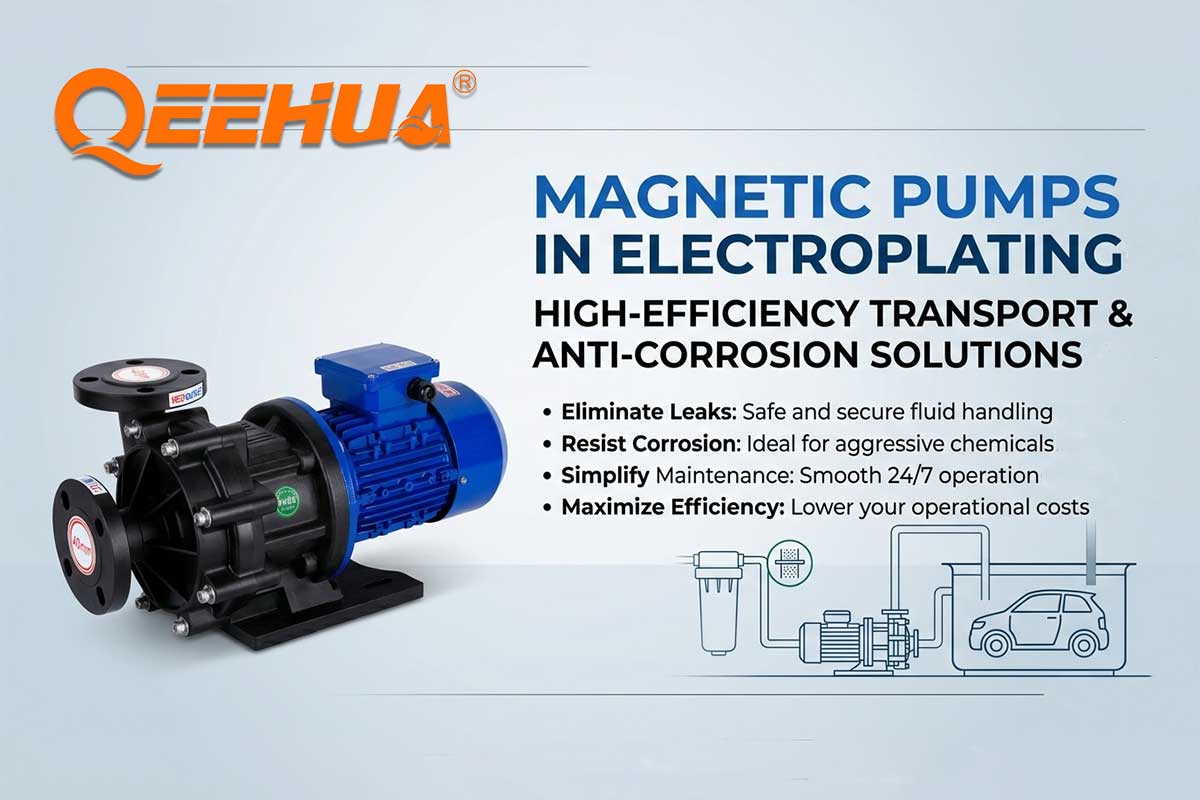
In industries like chemicals, pharmaceuticals, electroplating, semiconductors, and new energy, transferring chemical media must be safe, reliable, and efficient. Magnetic drive pumps (Magnetic Drive Pump / Mag Drive Pump) have become the go-to solution for hazardous chemical transfer thanks to their seal-less, leak-free, corrosion-resistant design. This guide explains how these pumps work, how to select the right model, common mistakes to avoid, and QEEHUA’s tailored solutions to help you find the perfect pump for your needs.
Related Field Cases
- PCB pump check valve failure shows how backflow and reverse rotation appear after shutdown even when the pump model itself is correct.
- PCB pump motor protection covers the environmental checks that matter when acid mist and splash attack the motor side of a magnetic drive installation.
- PCB alkaline developer and stripping pump selection gives a tighter material and seal-stability example for alkaline wet-process loops.
- Vanadium electrolyte precipitation and pump clogging is a useful application note when the same mag-drive logic is being applied to flow-battery circulation.
What is a Magnetic Drive Pump?
Also called a mag drive pump or magnetic coupling pump, a magnetic drive pump is a seal-less centrifugal pump that uses a magnetic coupling between an outer magnet (connected to the motor) and an inner magnet (connected to the impeller). This design eliminates the need for a mechanical seal and the risk of leakage.
How It Works
- The motor spins the outer magnet.
- The outer magnet’s field drives the inner magnet and impeller inside the isolation shell.
- The impeller pressurizes the liquid and pushes it into the piping.
- Since there is no shaft passing through the pump casing, the pump chamber stays fully sealed, achieving zero leakage.
Key Advantages
- Corrosion Resistance: Materials like PP, PVDF, PTFE, PFA, and SUS316 suit a wide range of acids, alkalis, and solvents.
- Leak-Free: Ideal for toxic, hazardous, flammable, explosive, or high-purity chemicals.
- Low Maintenance: No mechanical seals to wear out, reducing downtime and repair costs.
- Quiet Operation: Low vibration and minimal noise.
Why Magnetic Drive Pumps Are Ideal for Chemical Media
Suitable Media
- Strong acids: Sulfuric, nitric, hydrochloric acid.
- Strong alkalis: Sodium hydroxide, ammonia.
- Oxidizers: Sodium hypochlorite, hydrogen peroxide.
- Organic solvents: Methanol, acetone, ketones, esters.
Safety Advantage
The fully enclosed design prevents leaks, protecting workers and meeting chemical safety standards.
Environmental Compliance
A leak-free design reduces VOC emissions, helping companies comply with ISO14001 and industry environmental regulations.
Key Parameters to Confirm Before Selecting
-
Flow Rate & Head
- Flow rate determines delivery capacity.
- Head defines pumping height and pressure.
-
Media Temperature & Viscosity
- High temperatures require heat-resistant bearings and isolation shells.
- High viscosity demands extra motor power.
-
Corrosiveness & Material Selection
- PPH / PVDF: Most acids and alkalis.
- PTFE / PFA: Strong acids, strong alkalis, and solvents.
- SUS316: High-temp, medium-corrosion liquids.
-
Operating Environment & Installation
- Space limits may call for compact models.
- Consider explosion-proof motors, variable speed control, or smart protection features.
Material Comparisons & Applications
- Fluorine-Lined Mag Drive Pump: PTFE/PFA/F46 lining resists almost all chemicals. Ideal for semiconductors, new energy, and high-corrosion chemicals.
- Stainless Steel Mag Drive Pump: SUS304/SUS316 for high temperature, high pressure, or solids-containing media.
- PP/PVDF Mag Drive Pump: Lightweight, resistant to most acids and alkalis, commonly used in electroplating, environmental, and light chemical industries.
Common Selection Mistakes to Avoid
- Ignoring media temperature and pressure → material deformation or bearing failure.
- Incorrect flow/head selection → overload or low efficiency.
- Choosing the wrong material → corrosion, cracking, or reduced lifespan.
- Lack of protection devices → dry running, phase loss, or overload can damage the pump.
QEEHUA’s Magnetic Pump Solutions
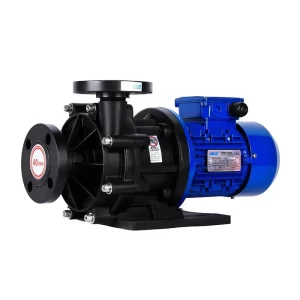
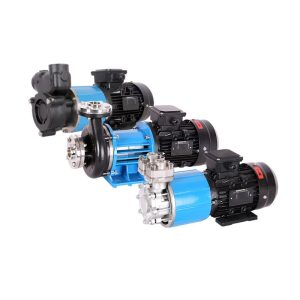
QEEHUA offers a wide range of corrosion-resistant mag drive pumps for various flows, heads, and chemical properties:


Core Advantages
- Zero leakage design
- Multiple corrosion-resistant material options
- Smart protection (dry run, overload, phase loss prevention)
- Custom solutions for special operating conditions
MANUFACTURER+TRADER EXPERT OF CHEMICAL FLUID EQUIPMENT
We not only offer high-performance chemical pumps, but also integrate upstream and downstream resources such as valves, pipelines, and control systems. We create integrated solutions that match the scenarios for industries like PCB, electroplating, and chemical engineering. Submit your requirements and we will tailor the best configuration for you.

Conclusion & Selection Advice
The key to choosing the right magnetic drive pump is knowing your chemical’s properties and operating conditions, then matching them with the right material and design.
QEEHUA offers one-on-one selection assistance to ensure safe, eco-friendly, and cost-effective chemical transfer.
What chemicals can magnetic drive pumps handle?
Acids, alkalis, solvents, oxidizers, hazardous, and high-purity chemicals.
How do I determine the right flow rate and head?
Calculate based on process needs, then add 10%-20% margin.
Can mag drive pumps handle high temperatures?
Yes, with heat-resistant materials and bearings, up to 150°C.
How can I extend pump lifespan?
Avoid dry running, keep the fluid clean, and regularly check the motor and couplings.