In industrial fluid transfer systems, pumps are the driving force. Their smooth operation is key to safety and efficiency. Among all the components, bearings are especially vulnerable. When lubrication fails, efficiency drops. Worse, the pump may overheat, shut down, or even break.
This is especially true for pumps with SiC (silicon carbide) bearings. These high-performance materials resist corrosion and heat but are highly sensitive to dry running. Without proper lubrication, damage happens fast.
For engineers, understanding these risks and setting up the right protection systems is essential. In this article, we dive into the common causes of bearing failure, explain how dry running damages pumps, and share real-world protection strategies used in QEEHUA chemical-resistant magnetic drive pumps.
Why Dry Running Is Dangerous: The Role of Lubrication
Magnetic drive pumps rely on the fluid they move to form a thin lubrication film between moving parts. This prevents hard surfaces from grinding against each other.
SiC bearings are strong, but they cannot withstand mechanical shocks without that lubrication. If the pump runs without liquid, heat builds up quickly. The lubrication film disappears, causing intense friction. Bearings crack. Impellers seize. The entire pump may fail.
8 Hidden System Issues That Threaten Your Bearings
It’s not always the pump’s design that causes failure. Sometimes, subtle system problems create unsafe conditions. Here are eight common but overlooked threats:
- Running the pump with a closed valve: This creates a sealed loop. Fluid can’t circulate. It heats up and evaporates.
- Low inlet pressure (NPSHa too low): Causes cavitation. Bubbles form and collapse near the bearings.
- Long-term operation at very low flow: Not enough movement to maintain lubrication.
- Overloaded operation at high flow: Vortexes disrupt the bearings.
- Frequent starts and stops: The pump never stabilizes, stressing the bearings.
- High temperature operation: Evaporates the fluid. Lubrication vanishes.
- Dry startup: Liquid hasn’t reached the chamber yet. Bearings grind immediately.
- Blocked impeller inlet: Insufficient fluid causes air pockets in the pump.
Even small issues like these can lead to serious damage if left unchecked.
Dry Run Protection: Not a Luxury, But a Lifeline
One of the best solutions is to monitor the pump’s power in real time. Sudden changes in power usage can signal dry running or other problems. Once a limit is crossed, the system can automatically shut down the pump.
QEEHUA’s magnetic drive pumps offer optional dry run protection. They include smart power monitoring. When dry running, impeller jams, or fluid evaporation occurs, the system sends an alert and stops the pump to prevent further damage.
This feature has already reduced pump failure rates by over 80% in plating lines, chemical dosing systems, and cooling loops. It also extends the life of bearings.
Why Magnetic Drive Pumps Are Built for Safety and Performance
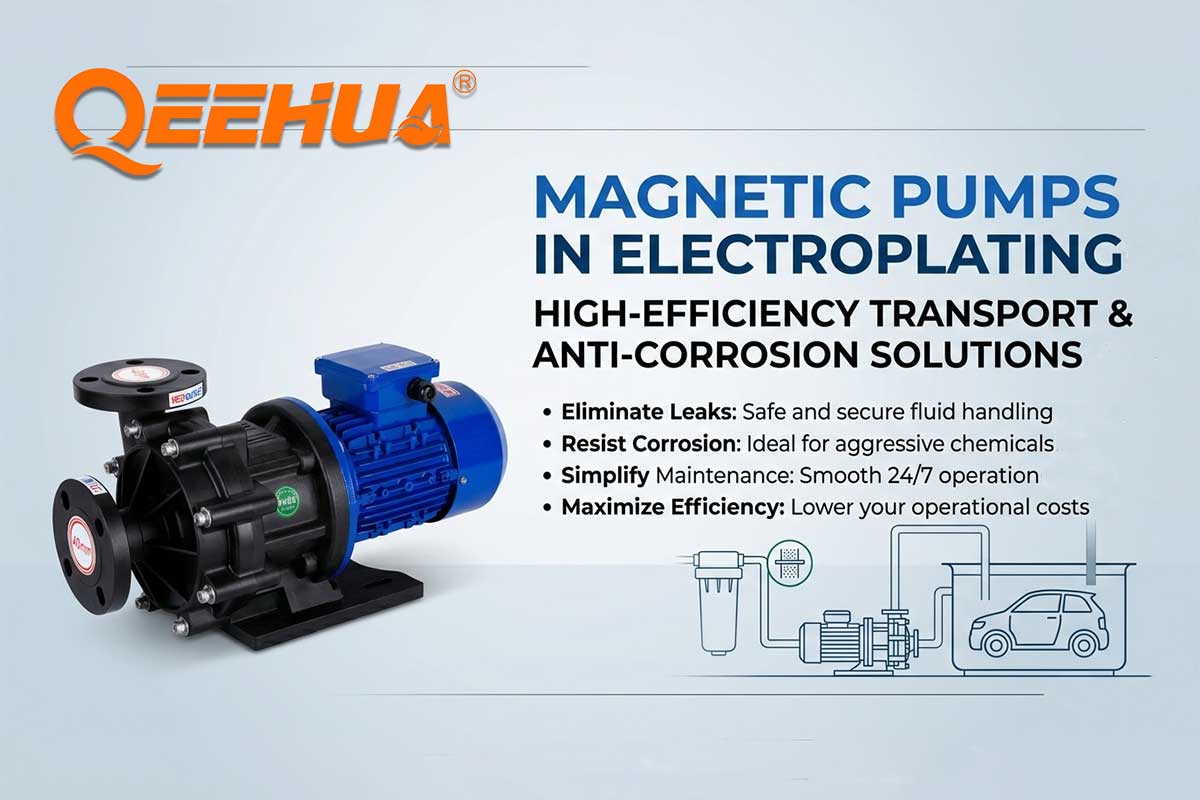
Compared to traditional mechanical seal pumps, magnetic drive pumps offer several key benefits:
- Seal-less design: No leakage risk
- Self-lubricating: No need for external oil
- Closed structure: Easier to protect and control
- High-performance materials (PVDF, PTFE, SiC): Resist acid and base liquids
- Flexible installation: Horizontal, vertical, in or out of tanks
When handling aggressive liquids like sulfuric, hydrochloric, or hydrofluoric acid, a corrosion-resistant magnetic pump isn’t just smart—it’s essential.
Selection Tips for Engineers: Don’t Just Focus on Flow Rate
In real-world projects, many engineers look only at specs like flow rate, head, and power. But the real challenge is keeping the system safe over time.
Here’s what to prioritize when choosing a pump:
- Does it have dry run protection?
- Are the bearings designed to handle impact?
- Is there a system monitoring interface?
- Are clog-resistant features included (like open impellers)?
QEEHUA has over a decade of experience in magnetic pump systems. We provide full solutions: from pump selection and system integration to fault detection and remote monitoring.
Conclusion: The Right Pump Keeps Your Project Running Smoothly
Dry running isn’t rare. It can happen in any system. If you’re using SiC bearings, keeping them properly lubricated is key to pump life.
By choosing a corrosion-resistant magnetic pump with built-in dry run protection, engineers can prevent costly failures and ensure long-term reliability.
With the right setup, you can stop worrying about breakdowns and focus on performance.