


For broader selection context, see Guide to Choosing Seal-less Magnetic Drive Pumps.
Magnetic drive pump deadheading happens when the pump keeps running while the discharge path is closed or flow falls below the safe minimum. In a chemical line, this is different from dry running: the pump still contains liquid, but that liquid is trapped inside the casing and can heat quickly. For buyers comparing a chemical magnetic pump, the key question is not only whether the pump is sealless, but whether the installation, controls, and operating procedure prevent closed-discharge and low-flow events.
This matters in PCB wet process, electroplating, scrubber circulation, electrolyte circulation, and chemical transfer skids because operators often close valves during cleaning, batch changeover, filter replacement, or standby switching. A mechanically sealed pump may show leakage first. A magnetic drive pump may stay externally leak-free while the internal liquid temperature rises, bearings lose lubrication film, or the magnetic coupling decouples. By the time the line notices no flow, the pump may already have heat damage.

Deadheading vs. Dry Running
Dry running means the pump operates without enough liquid in the casing or suction line. Deadheading means the pump is full of liquid but cannot move it out through the discharge side. Both can create heat and internal damage, but the field clues are different.
| Condition | Typical cause | Field symptom | Process risk | Immediate action |
|---|---|---|---|---|
| Deadheading | Closed discharge valve, blocked filter, closed check valve, control valve failure, no open bypass | Very low or zero flow, discharge pressure near shutoff head, casing temperature rising | Liquid heating, vapor pockets, thrust loading, plastic deformation, bearing and impeller damage | Stop the pump, open a verified flow path, check discharge blockage before restart |
| Dry running | Empty tank, lost prime, suction valve closed, air binding, vortexing at low tank level | No flow, noisy operation, rapid internal heat, possible low current depending on design | Bearing heat, magnet damage, ceramic or SiC cracking, melted thermoplastic parts | Stop the pump, restore liquid supply, vent air, inspect internal parts before restart |
| Cavitation or flashing | Low NPSHa, hot liquid, clogged suction, excessive suction lift, volatile chemical | Noise, vibration, unstable flow, pitted impeller surfaces over time | Hydraulic damage, loss of flow, accelerated wear, possible dry-run-like heat marks | Correct suction conditions and temperature margin before increasing pump speed |
External industry guidance for magnetic drive chemical pumps repeatedly points to the same principle: liquid flow is part of the cooling and lubrication system. QEEHUA local product materials make the same practical point for plant operation: magnetic pumps and horizontal centrifugal pumps should not run dry, and protection against dry running, overload, and phase loss is a major reliability concern in chemical service.
Why Deadheading Damages Magnetic Drive Pumps
A magnetic drive pump replaces the dynamic shaft seal with a magnetic coupling and containment structure. That is why it is attractive for corrosive, odorous, or leakage-sensitive chemicals. But the pump is still a centrifugal machine. It needs stable flow through the wet end so heat can leave the pump and the rotating parts remain hydraulically balanced.
During deadheading, the impeller keeps adding energy to a small trapped volume of liquid. The liquid recirculates inside the casing instead of carrying heat downstream. If the operator leaves the pump in this state, the casing temperature rises, vapor can form, thrust surfaces see abnormal loading, and thermoplastic parts may soften or deform. In a magnetic drive pump, this can also create a secondary problem: the magnetic coupling may lose synchronism if torque demand changes sharply, especially with high specific gravity liquids, solids blockage, or a sudden change in batch chemistry.
The risk is higher when the liquid is hot, close to its vapor pressure limit, easy to crystallize, or more viscous than expected. QEEHUA’s product knowledge materials identify PPH, PVDF, CFRETFE, FEP, PFA, stainless steel, SiC, ceramic, PTFE, EPDM, and FKM as common material choices across magnetic, centrifugal, and vertical pump families. That does not mean one material solves deadheading. It means the pump material, seal elastomer, bearing pair, liquid temperature, and duty point must be checked together.
Symptoms and Root Causes on Chemical Lines
Maintenance teams usually discover deadheading from one of five clues: a hot pump casing, zero or unstable flow, unexpected pressure behavior, a damaged bearing or thrust surface after disassembly, or repeated trips from a motor protection device. In some installations, motor current may be lower at shutoff than at normal flow, so a simple overload relay may not catch the event. That is why process logic matters.
Common field causes include a discharge valve left closed after maintenance, a filter housing isolated during cartridge or bag replacement, a check valve stuck shut, a control valve failing closed, or a PLC sequence that starts the pump before a downstream valve has actually opened. On OEM skids, another frequent cause is using the pump curve only for rated flow and head while ignoring minimum continuous flow, bypass routing, and startup interlocks.
For PCB and electroplating systems, deadheading often appears near filtration loops, developer circulation, plating bath circulation, or chemical dosing transfer points. A related QEEHUA article on magnetic drive pump selection for PCB wet process lines explains why chemical compatibility and stable circulation matter. Deadheading is the operating-risk side of that same selection problem: the pump may be chemically suitable, but still fail if the line allows no-flow operation.
Specification Checks Before Buying or Retrofitting
A closely related QEEHUA reference is How to Choose a Magnetic Drive Pump for Handling Chemical Media (Complete Selection Guide).
A closely related QEEHUA reference is PCB Etching Pump Running Backwards: Symptoms, Risks, and Phase-Sequence Fixes.
If you are buying a new pump or correcting a repeated failure, do not start with horsepower alone. Start with the actual duty cycle: liquid name and concentration, temperature range, specific gravity, viscosity, vapor pressure, solids content, crystallization tendency, suction condition, discharge control method, and minimum operating flow.
| Spec item | Why it matters for deadheading | What to confirm |
|---|---|---|
| Minimum continuous flow | Below minimum flow, internal recirculation and heat rise increase even if the pump is not fully deadheaded. | Ask for the safe flow range, not only the rated best-efficiency point. |
| Discharge valve and bypass layout | A pump can be deadheaded by one closed valve if there is no verified alternate path. | Use a minimum-flow bypass, pressure relief path, or flow-confirmed startup logic where the process needs it. |
| Specific gravity and viscosity | Higher load can increase torque demand and decoupling risk. | Check the pump curve and coupling rating against the heaviest operating batch, not only water. |
| Temperature and vapor pressure | Hot or volatile liquids can flash faster under low-flow heat buildup. | Keep suction margin and temperature margin; avoid treating hot service like ambient water. |
| Crystallization and solids | Crystals or particles can block flow paths and cause local rubbing or decoupling. | Use proper filtration, flushing, and material choices for plating and PCB chemicals. |
| Protection device and PLC logic | Deadheading may not look like simple motor overload. | Combine pump protection with valve feedback, flow switch, pressure switch, or temperature alarm as needed. |
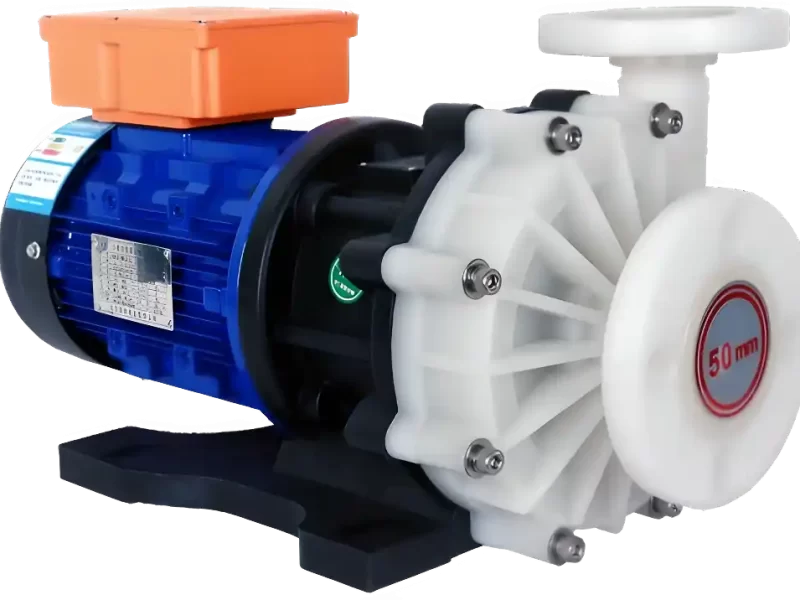
QEEHUA’s QHX Series magnetic pump is commonly evaluated for corrosive chemical circulation, PCB wet process, and electroplating applications. When specifying this type of pump, the practical question is not just pump model selection. It is whether the final line design keeps the pump inside its allowed hydraulic window during startup, production, cleaning, standby, and abnormal valve states.
Protection and Maintenance Checklist
Plant managers and OEM engineers can reduce deadheading risk by building a short, enforceable checklist into commissioning and maintenance. First, verify the normal flow path with valves in real operating positions, not only on the drawing. Second, confirm that filter housings, bag filters, cartridge filters, and check valves cannot create a closed discharge path without a trip or alarm. Third, define a maximum allowed no-flow time for startup and abnormal operation.
Protection should be layered. The QEEHUA pump protection device is relevant where dry running, overload, or phase loss can damage horizontal pumps. For deadheading specifically, combine electrical protection with process-side confirmation: flow switch, discharge pressure trend, temperature switch near the pump, valve-open feedback, or a minimum-flow bypass. This is especially important when the pump handles high-value chemicals, heated solutions, or crystallization-prone plating baths.

During maintenance, record the condition of bearings, thrust rings, impeller surfaces, and containment components. Heat discoloration, melted plastic, cracked ceramic, rubbed thrust surfaces, and repeated coupling slip are clues that the problem is not only material compatibility. They often point back to dry running, deadheading, cavitation, blocked suction, or an operating point far from the intended curve.
For scrubber systems, batch transfer skids, and PCB/electroplating circulation loops, it is also useful to train operators on the difference between “pump on” and “flow confirmed.” A pump running with a closed discharge valve may sound normal for a short period. The correct control target is verified flow, verified suction supply, and a verified open discharge path.
QEEHUA has also published a related guide on preventing pump dry-running. Use that as a companion reference, but treat deadheading as a separate process-control risk. Dry-run protection is necessary, but closed-discharge protection may need additional instrumentation and line design.
For a related troubleshooting angle, review PCB Developer Pump Gas Binding: Causes, Risks, and Fixes for Wet Process Lines before finalizing the pump decision.
For a related troubleshooting angle, review Magnetic Drive Pumps: The Ultimate Guide to Working Principles & Selection (2026) before finalizing the pump decision.
FAQ
Can a magnetic drive pump run against a closed discharge valve?
Only for a very short controlled startup condition if the pump manufacturer and process design allow it. Continuous operation against a closed discharge valve is unsafe because the trapped liquid heats inside the pump and can damage bearings, impeller parts, containment components, or thermoplastic casing parts.
Is deadheading the same as dry running?
No. Dry running means the pump lacks liquid. Deadheading means the pump contains liquid but has no discharge flow. Both can create heat damage, but the valve positions, pressure readings, and corrective actions are different.
What is the fastest sign of deadheading in a chemical pump?
The most useful early signs are zero or very low flow, abnormal discharge pressure, and a casing temperature that rises while the pump is still running. Motor current alone may not be enough to diagnose the condition.
How should an OEM protect a magnetic drive pump on a chemical skid?
Use layered protection: a defined minimum-flow route, valve-open feedback before pump start, a flow or pressure switch, temperature monitoring where needed, and electrical protection for dry running, overload, and phase loss. The exact combination depends on the liquid, duty cycle, and consequence of failure.
Which QEEHUA pump material is best for deadheading?
No material should be selected to tolerate deadheading as a normal operating mode. Choose PPH, PVDF, CFRETFE, fluoroplastic-lined, stainless steel, elastomer, and bearing materials according to the chemical, temperature, and solids risk, then design the system to prevent no-flow operation.
If you are reviewing a chemical circulation line that has deadheading, dry-running, overheating, or repeated bearing failure, share the liquid, temperature, flow, head, valve sequence, and failure photos with QEEHUA. Email QEEHUA at info@qeehua.com for application-specific pump selection and protection guidance.
