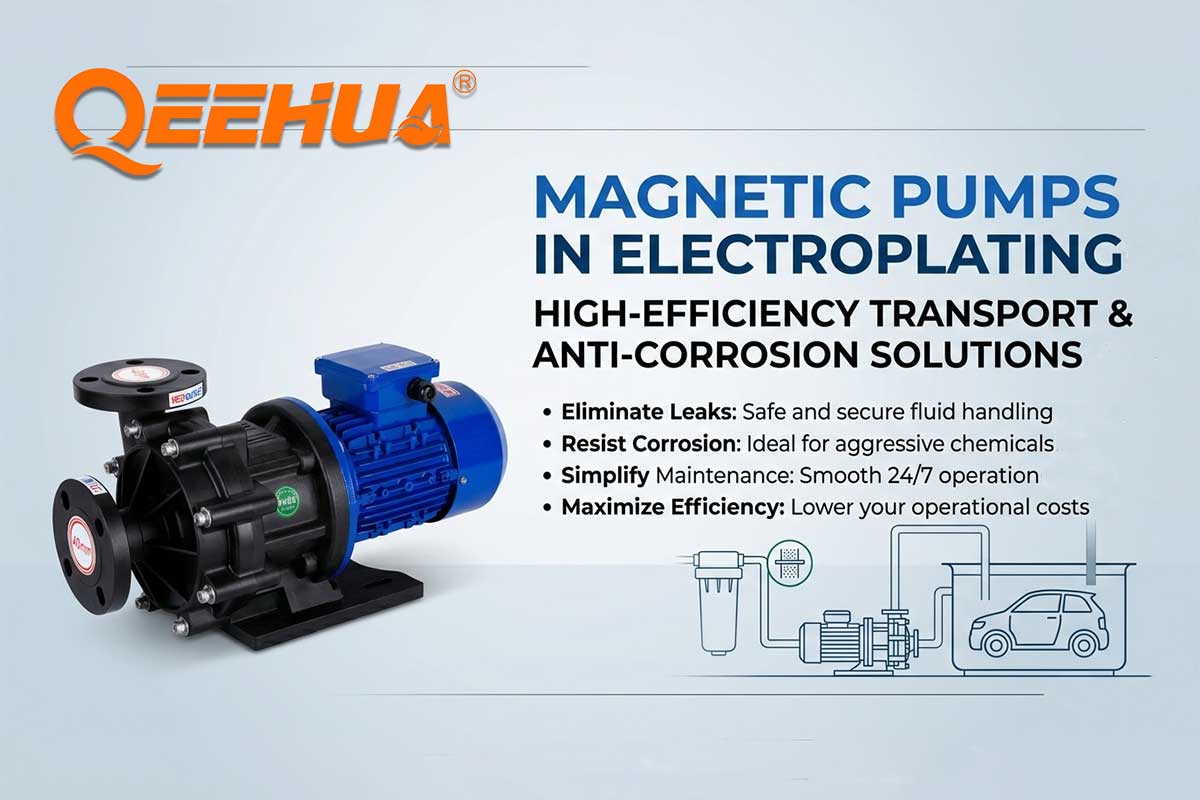
In the world of chemical transfer, leak prevention isn’t just a bonus—it’s a necessity. Especially in industries like electroplating, semiconductors, or chemical manufacturing, one unnoticed leak can lead to hazardous spills, costly downtime, or even safety violations.
That’s where magnetic pumps, or mag drive pumps, step in as silent heroes.
But how exactly do magnetic drive centrifugal pumps prevent leaks so effectively? Let’s break it down.
What Makes Magnetic Pumps Leak-Proof?
Imagine a traditional pump—inside, a mechanical seal protects the fluid path where the shaft penetrates the casing. It’s the weak point. Over time, friction, corrosion, and chemical exposure wear that seal down until… drip, drip, drip.
Now imagine removing that seal altogether.
That’s exactly what magnetic pumps do.
“In 2022, a plating plant in Shenzhen switched to QEEHUA’s magnetic centrifugal pumps for their hydrochloric acid circulation line. The result? Zero leak incidents and a 32% drop in maintenance calls within six months.” — From QEEHUA PUMP case archive
Let’s dive deeper:
1. Magnetic Coupling: Power Without Penetration
Mag drive centrifugal pumps transmit torque through powerful magnets—there’s no physical connection between the motor and the fluid chamber. Instead, a magnetic field rotates the impeller. No mechanical shaft enters the pump housing, so there’s nothing to leak around.
This is called a sealless design, and it’s what makes magnetic drive pumps virtually leak-proof.
-
✅ No friction
-
✅ No wear points
-
✅ No need for constant seal replacement
2. Fully Enclosed Housing: Hermetically Sealed Safety
The pump’s internal components (impeller, shaft, and bushings) are completely enclosed in a solid casing, often made from corrosion-resistant materials like ETFE or PVDF. Combined with O-rings, this creates a double-layer containment system, ideal for transferring hazardous or toxic chemicals.
QEEHUA’s magnetic drive chemical pumps use patented “inner-magnet injection molding” to achieve seamless, one-piece containment—making cracks and seepage almost impossible.
3. Material Science Matters
A magnetic pump’s resistance to leaks also comes from its robust material selection:
-
Magnets: Neodymium or Samarium Cobalt
-
Shafts: Silicon Carbide
-
Bearings: Carbon bushings or ceramic
-
Housing: Glass-fiber reinforced PP or PVDF
The result? Unmatched durability and long-lasting performance in even the harshest environments.
Why Go Magnetic? 6 Real-World Benefits of Mag Drive Pumps
Here’s why more engineers, maintenance leads, and plant managers are switching to magnetic drive pumps:
✅ Leak-Free Operation
Ideal for flammable, toxic, or corrosive fluids. No mechanical seal = no leak risk.
✅ Reduced Maintenance
No seals to replace, no alignment issues, no downtime. Some QEEHUA models run maintenance-free for 3+ years.
✅ Enhanced Worker Safety
No exposure to harmful leaks or emissions means fewer accidents and better compliance.
✅ Lower Lifetime Cost
Yes, magnetic pumps may cost more upfront—but you save on repairs, seal replacements, and cleanup.
✅ Smooth, Pulsation-Free Flow
Accurate and steady flow makes them perfect for sensitive processes like electroplating or semiconductor etching.
✅ Environmental Compliance
Leakage regulations are tightening worldwide. Sealless magnetic pumps help you stay compliant.
QEEHUA: A Professional Leader in Chemical Fluid Equipment
800X800-300x200.jpg "Magnetic Pumps Collection(MD、QHX、QB)800X800")
QEEHUA: Trusted Magnetic Pump Manufacturer Since 2010
As one of the leading magnetic pump manufacturers in China, QEEHUA PUMP serves over 10,000 global clients in industries like:
-
PCB manufacturing
-
Electroplating and surface finishing
-
Semiconductor and solar energy
-
Chemical processing
-
Wastewater and acid transfer
With ISO9001, CE, SGS certifications, and proprietary technologies like inner-magnetic injection molding, QEEHUA sets the standard for high-quality magnetic drive pumps.
Need custom pump solutions? Our engineers specialize in configuring pumps for aggressive chemicals, high flow rates, or tight space constraints.
Conclusion: A Smart, Safe Investment
Mag drive pumps are more than a leak-free solution—they’re a leap forward in process safety, reliability, and environmental responsibility.
If your plant still relies on mechanical seals and routine maintenance to keep things from leaking, it might be time to make the switch.
QEEHUA’s magnetic centrifugal pump technology isn’t just an upgrade—it’s a transformation.
Ready to learn more or request a quote?
👉 Contact QEEHUA PUMP Today
FAQ | Magnetic Pumps Explained
Here are 20 common questions about magnetic pumps and mag drive centrifugal pump systems, with quick answers for busy engineers:
-
What is a magnetic drive pump?
A pump using magnetic coupling to drive the impeller without a mechanical seal. -
How do magnetic pumps prevent leaks?
They eliminate the need for a mechanical shaft seal, the most common leak point. -
Are mag drive pumps safe for acids?
Yes. QEEHUA pumps are built with corrosion-resistant materials. -
Can a mag drive pump run dry?
Some can. QEEHUA models with carbon bushings can handle short dry-run events. -
Are magnetic pumps energy-efficient?
Yes, especially in continuous-duty applications with corrosive fluids. -
What industries use magnetic drive pumps?
Electroplating, chemical manufacturing, pharmaceuticals, solar, mining, and more. -
What materials are used in magnetic pumps?
PVDF, PTFE, CFR-PP, ceramic, and high-grade magnets like Neodymium. -
Do magnetic pumps need maintenance?
Minimal. No seal to replace. Check bushings and impellers annually. -
What’s the lifespan of a magnetic pump?
Often exceeds 5 years with proper use. -
What is the price of a magnetic pump?
Depends on flow rate, materials, and features. Contact QEEHUA for quotes. -
Are mag drive pumps explosion-proof?
They can be paired with explosion-proof motors for ATEX compliance. -
What is the max temperature a magnetic pump can handle?
Up to 120°C depending on material. -
Do magnetic pumps work for slurries?
Limited. Avoid solid-heavy fluids unless specified. -
How is torque transferred in a magnetic pump?
Via synchronized magnets in the motor and impeller housing. -
Can I replace a mechanical seal pump with a mag drive pump?
Usually, yes—with the right flow, head, and chemical compatibility. -
Is there a magnetic pump for high-pressure applications?
Yes, reinforced housings and strong magnets allow up to 12 bar pressure. -
Are magnetic pumps quiet?
Very. No shaft friction means smoother, quieter operation. -
What certifications should a magnetic pump have?
ISO9001, CE, and for some industries, SGS or FDA compliance. -
What’s the difference between a magnetic centrifugal pump and diaphragm pump?
Mag pumps are sealless centrifugal; diaphragm pumps use flexible membranes. -
Why choose QEEHUA magnetic pumps?
Proven reliability, patented tech, expert support, and fast global delivery.