

Master sealless magnetic drive pumps. Ensure zero-leakage chemical handling for safe industrial operations.
Table of Contents
Understanding Magnetic Drive Technology
Sealless magnetic drive pumps represent the pinnacle of fluid containment technology. These pumps utilize a magnetic coupling to transmit torque from the motor to the impeller. This eliminates the need for a traditional mechanical shaft seal. Mechanical seals remain the primary cause of leaks in centrifugal pumps. By removing this vulnerability, magnetic drive pumps provide a hermetically sealed environment. This design ensures that hazardous fluids stay inside the system. Safety officers in the mining and wastewater sectors prioritize these pumps for their leak-free performance. High-performance magnets, such as Neodymium or Samarium Cobalt, provide the necessary torque for demanding industrial tasks.
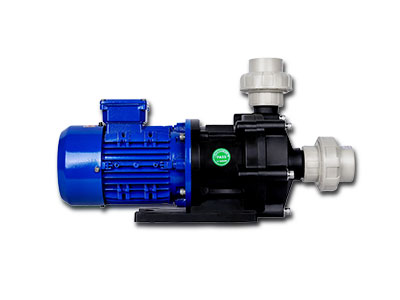
The internal assembly consists of an outer magnet, an inner magnet, and a containment shell. The containment shell creates a static barrier between the process fluid and the environment. Modern magnetic drive pumps handle highly corrosive liquids with ease. Engineers often specify materials like Carbon Fiber Reinforced Polypropylene or ETFE for the wetted parts. These materials withstand aggressive acids and bases found in electroplating lines. Operators must monitor the temperature within the containment shell to prevent magnet demagnetization. Precise engineering ensures that the pump operates within its thermal limits during continuous production cycles.
Core Benefits of Sealless Design
Leak prevention serves as the most critical advantage of this technology. Environmental regulations continue to tighten across global markets. A single leak can result in significant fines and environmental damage. Magnetic drive pumps mitigate these risks by providing total containment. This is particularly vital when handling sodium hypochlorite or caustic soda. These chemicals off-gas and crystallize, often damaging traditional seals. The sealless design removes the seal interface where crystallization typically occurs. This reduction in failure points leads to longer Mean Time Between Maintenance (MTBM).
Key Advantages Table
| Feature | Benefit | Impact on Operations |
|---|---|---|
| Zero Mechanical Seals | Zero Leakage | Higher Safety and Lower Risk |
| Hermetic Containment | Environmental Compliance | Avoidance of Regulatory Fines |
| Corrosion-Resistant Lining | Chemical Versatility | Longer Equipment Lifespan |
Maintenance costs decrease substantially over the pump’s lifecycle. While the initial investment might be higher, the total cost of ownership remains low. Mechanical seals require frequent replacement and precision alignment. Magnetic drive pumps eliminate the complex seal support systems often required for hazardous chemicals. This simplifies the overall system design. Users save on spare parts and labor hours. In the PCB industry, where uptime is paramount, these pumps deliver consistent performance. They support the “one-stop service” concept by integrating seamlessly with chemical tanks and digital flow meters.
Industrial Application Insights
The mining industry utilizes magnetic drive pumps for solvent extraction processes. These processes involve volatile organic compounds that pose fire risks. Sealless pumps prevent vapor escape, maintaining a safe atmosphere for workers. In wastewater treatment, these pumps handle polymer dosing and chlorine transfer. The precise flow control ensures efficient water purification. Automation-ready models feature digital interfaces for PLC integration. This allows for real-time monitoring of flow and pressure from a centralized control room.
Electroplating lines rely on chemical pumps to maintain precise chemical concentrations. Fluctuations in flow can lead to uneven plating thickness on PCB boards. Magnetic drive pumps provide steady, pulse-free flow, which is essential for high-quality PCB manufacturing. They are superior to pulse-output pumps for continuous flow requirements. When selecting a pump, verify the specific gravity of the liquid. High-density chemicals require larger magnetic couplings to prevent “de-coupling” or slipping. Our range of QHX and MD series pumps caters to various flow rates and pressure requirements.
Installation and Optimization Strategies
Proper installation guarantees long-term reliability. Always install the pump on a level foundation. Use epoxy resin coatings to protect the base from acid mist corrosion. This is a common pain point in PCB workshops. Misalignment causes vibration and premature wear. Ensure that the coupling alignment tolerance is within 0.03mm. Use a dial indicator for precise calibration. Rigid piping can stress the pump casing. Install flexible connectors at the suction and discharge ports. Replace these connectors every three months to prevent cracking from aging.
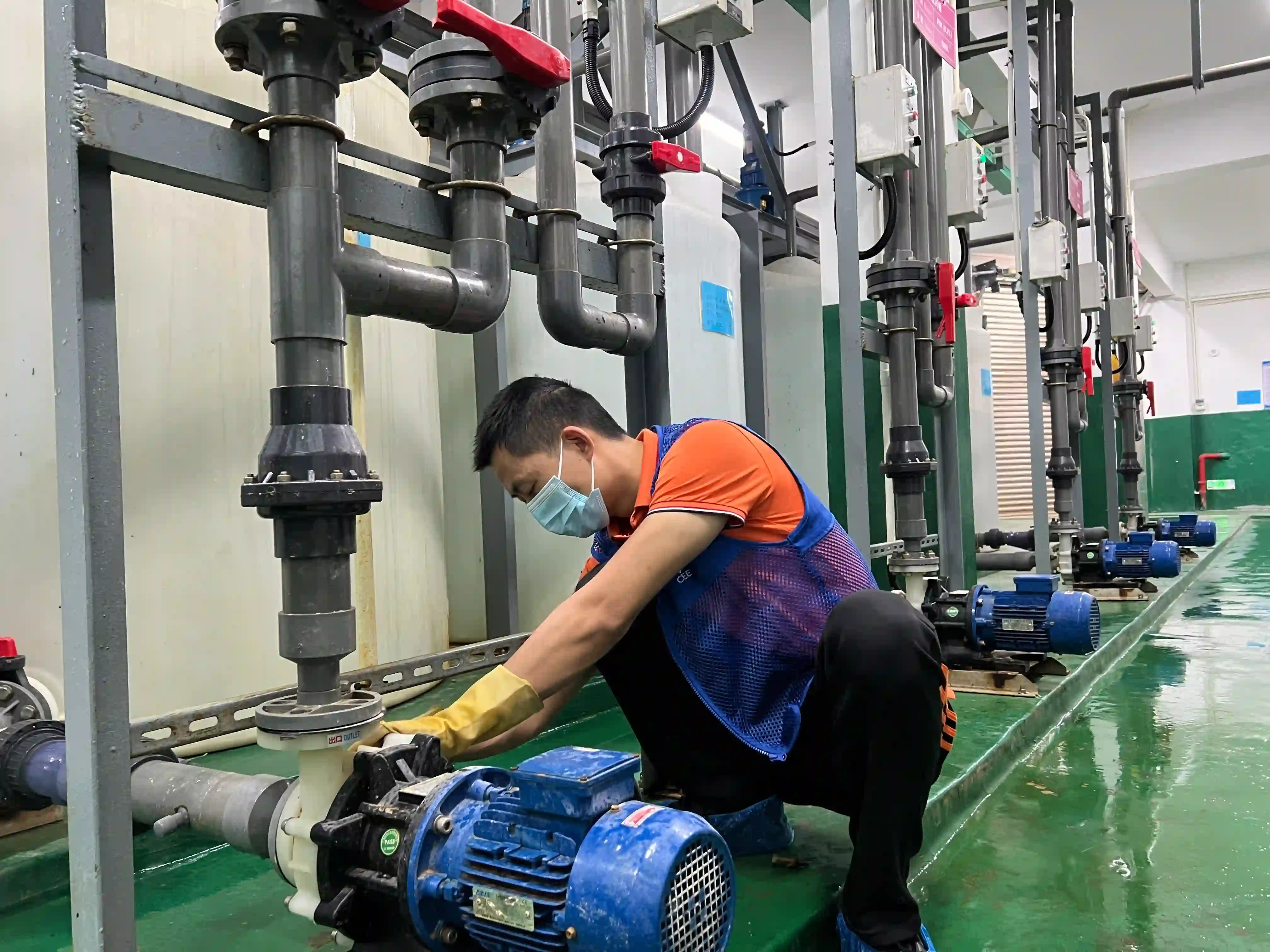
Suction piping design determines the pump’s efficiency. The suction pipe diameter must be equal to or larger than the pump inlet. Use eccentric reducers to prevent air pockets. Air ingress causes cavitation, which destroys the internal components of a magnetic pump. Ensure the NPSH available exceeds the NPSH required by at least 0.5 meters. In the electroplating industry, installers often place the pump too far from the tank. Keep the suction line as short and straight as possible. This minimizes friction losses and prevents suction-side issues.
Common Pain Points and Professional Solutions
Dry running remains the leading cause of failure for magnetic drive pumps. These pumps use the process fluid for lubrication and cooling. Running dry leads to rapid heat buildup and catastrophic damage to the bushings. Install dry-run protectors or power monitors to shut down the pump automatically. Another common issue is magnetic particle accumulation. Iron filings in the fluid can clog the containment shell. Use a magnetic filter at the suction side to capture these particles. This is especially critical in mining applications where metallic fines are prevalent.
Troubleshooting Matrix
| Problem | Potential Cause | Actionable Solution |
|---|---|---|
| Reduced Flow | Inlet Clogging | Clean suction strainers and check valves |
| Abnormal Noise | Cavitation | Lower the pump or increase suction pipe size |
| Overheating | Restricted Discharge | Check valves and piping for obstructions |
PCB production often faces issues with foundation instability due to vibration. This instability leads to equipment shift and pipe leakage. Install high-quality anti-vibration pads to dampen motor noise and movement. For fine-line PCB etching, minimize vibration to prevent scratches on the delicate copper layers. Regularly check the mounting bolts for tightness. Use stainless steel fasteners to resist the corrosive atmosphere of the plating shop. These simple steps significantly reduce the frequency of emergency repairs.
Future Trends in Chemical Pumping
Digitalization is transforming the pump industry. Smart magnetic drive pumps now feature integrated sensors. These sensors monitor vibration, temperature, and power consumption. Operators use this data for predictive maintenance. This shift reduces unexpected downtime. Energy efficiency is another major focus. Modern motor designs comply with IE3 and IE4 standards. This reduces electricity costs in 24/7 manufacturing plants. Companies now seek “one-stop” providers who supply the entire system, including chemical tanks and auxiliary fittings.
The demand for sustainable manufacturing drives the adoption of sealless technology. Eliminating leaks protects workers and the planet. Our commitment to quality ensures that our products meet the highest international standards. We provide premium chemical handling solutions that rival brands like Simona and Röchling. Invest in reliable equipment today to safeguard your production future. Our team is ready to assist you with selection, installation, and long-term support.
