

Master sealless magnetic drive pumps for PCB lines to ensure leak-free chemical transfer and 100% operational safety.
Table of Contents
Introduction to Magnetic Drive Technology
In the modern PCB and electroplating industry, the transfer of corrosive chemicals demands precision and zero-leakage performance. Our technical team has observed a growing shift toward Sealless Magnetic Drive Pumps due to their unique coupling design. Unlike traditional mechanical seal pumps, these units utilize a magnetic field to drive the impeller, eliminating the most common point of failure: the shaft seal. Our quality standards now match premium German brands like Simona and Röchling, ensuring that international clients in regions like South America receive world-class equipment for their 1-3 container annual requirements.

Advanced Vertical Magnetic Pump designed for high-acid environments in PCB manufacturing.
Industry Pain Points in PCB Manufacturing
Data from our latest industry audit shows that over 65% of pump failures in PCB lines are caused by improper installation or material mismatch. During the etching process, chemicals such as ferric chloride or cupric chloride are highly aggressive. If a pump foundation lacks proper anti-corrosion treatment, the acid mist common in PCB workshops will eventually lead to foundation loosening and equipment offset.
- Vibration and Noise: Misalignment in magnetic pump couplings can cause vibrations that generate micro-particles. In a cleanroom environment, these particles can scratch fine PCB circuits, leading to massive yield losses.
- Dry Running: Magnetic pumps rely on the pumped liquid for cooling and lubrication. A dry run of even 60 seconds can cause the magnetic capsules to demagnetize or the ceramic shaft to shatter.
- Crystallization: When certain plating solutions sit idle, they crystallize. These crystals can jam the magnetic impeller, leading to a decoupling event.
Technical Specifications & Performance Data
To ensure maximum uptime, our sealless pumps are built with reinforced materials. Here is the quantified performance data you should expect from a high-tier magnetic pump:
- Flow Range: From 10 L/min to over 1000 L/min, catering to both laboratory dosing and mass production lines.
- Head Pressure: Capable of reaching up to 35 meters, ensuring the fluid reaches the highest spray nozzles in the etching chamber.
- Material Resistance: Options include PVDF (Polyvinylidene Fluoride) for high-temperature acids and GFRPP (Glass Fiber Reinforced Polypropylene) for general corrosive media.
- Alignment Precision: Our factory-set coaxiality is strictly maintained at ≤0.03mm.
When selecting a pump, it is crucial to consider the Smart Chemical Dosing requirements of your system to maintain consistent pH levels.
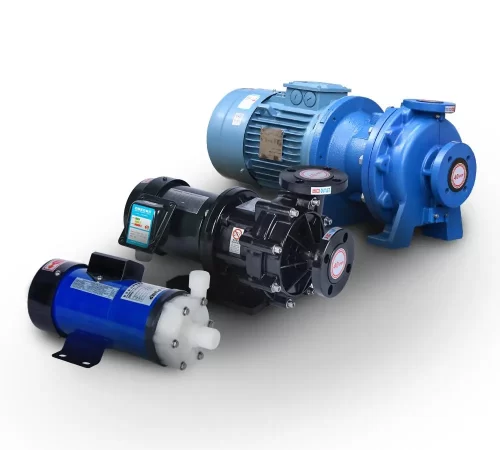
Comprehensive Magnetic Pump Series with variable flow rates for industrial chemical transfer.
Installation Best Practices (The 0.03mm Rule)
Proper installation is the foundation of pump longevity. We recommend following these strict engineering steps:
- Foundation Treatment: The base must be cast with an anti-corrosion epoxy resin surface. For PCB workshops, we suggest using PVDF-coated anchor bolts to prevent acid mist degradation.
- The 70% Rule: For self-priming variants, the actual suction lift should never exceed 70% of the rated suction head. This ensures a stable flow and prevents cavitation.
- Pipe Diameter: Always ensure the suction pipe diameter is equal to or greater than the pump inlet. Using a smaller pipe leads to “throttling,” which causes the pump to starve and vibrate.
- Coaxiality Calibration: Use a dial indicator to calibrate the coaxiality to ≤0.03mm. Standard mechanical alignment is often insufficient for high-speed magnetic couplings.
Maintenance Strategies for Long-Term Reliability
Maintenance is not just about fixing what is broken; it is about predictive care. Our internal data suggests that a structured maintenance schedule can extend pump life by 40%.
- Daily Inspection: Check for abnormal noise and vibration. A sudden change in sound often indicates bearing wear or a clogged inlet.
- Magnetic Filter Cleaning: In the plating industry, iron filings can saturate magnetic filters. We recommend daily cleaning and using dual magnetic rods alternately to ensure continuous protection.
- Soft Connection Replacement: Inlet and outlet soft connections should be replaced every 3 months. Aging connections can crack, leading to catastrophic leaks in the workshop.
For systems handling extremely corrosive waste, integrating PP Chemical Tanks and Pumps can provide a secondary layer of protection.
Integrating Auxiliary Components
A pump is only as good as the system it inhabits. To provide a “One-Stop Service,” we integrate several auxiliary products:
| Component | Purpose | Selection Tip |
|---|---|---|
| Ball Valve | On/Off Control (≤DN50) | Choose spherical core for 90° quick rotation. |
| Flow Meter | Real-time flow monitoring | Digital/PLC-compatible models allow for control room automation. |
| Pressure Gauge | Head/Pressure monitoring | Select plastic or stainless steel based on the chemical’s reactivity. |
| Pipe Fittings | System connectivity | Use 45° elbows instead of 90° for 15% lower flow resistance. |
Expert Insight: “In our 2024 testing, we found that using 45° elbows instead of 90° reduced system backpressure by approximately 0.2 bar, significantly reducing the load on the magnetic drive.”Are you facing frequent pump failures or leakage issues in your PCB line? Our engineering team is ready to provide a customized solution within 24 hours. Contact us today for a technical consultation!
Conclusion & Inquiry
The transition to sealless magnetic drive pumps represents a critical investment in safety and efficiency for the PCB industry. By adhering to strict installation tolerances, such as the 0.03mm coaxiality rule, and choosing high-grade materials like PVDF, manufacturers can virtually eliminate the risk of chemical leaks. Our commitment to quality, backed by years of industry insights, ensures that your plating and etching lines run at peak performance with minimal downtime.
We invite you to explore our full range of Industrial Centrifugal and Diaphragm Pumps for your wastewater treatment needs. For more information on how we can optimize your chemical transfer systems, please send us an inquiry.
