



Direct answer
Vertical pump submergence in a PCB wet process tank should keep the pump inlet fully covered at the lowest real operating liquid level, with enough liquid above and around the inlet to prevent vortex formation, foam ingestion, air entrainment, dry running, and unstable flow. A practical specification should not say only “keep pump submerged.” It should define the minimum liquid level, alarm level, shutdown level, inlet clearance, flow variation limit, and inspection frequency.
For engineering use, treat the pump maker’s minimum level as the baseline. Then add a site margin for drawdown, foam, return turbulence, filter pressure rise, and operator delay. In many PCB tanks, the useful acceptance test is simple: at the lowest permitted level, the pump should run for 10-15 minutes with no visible vortex, no air bubbles in the discharge, stable motor current, and flow variation held within the process limit.
This article is about tank-side vertical pump installation. If the symptoms come from pipe-side high spots, compare it with QEEHUA’s guide to PCB pump suction piping air pockets. If the symptoms are mainly gas accumulation after startup, also review PCB developer pump gas binding.
Quantified checkpoints
The values below are not universal standards. They are practical acceptance points that help engineers turn a vague level discussion into a measurable commissioning sheet. Always confirm the final minimum liquid level with the QEEHUA pump selection team or the pump curve and installation drawing.
| Item to quantify | How to record it | Why it matters |
|---|---|---|
| Minimum operating level | mm above tank bottom or mm above pump inlet reference point | Prevents dry running and defines the lowest safe production level. |
| Alarm level | Set above the unstable-flow point, not below it | Warns operators before vortex or air ingestion begins. |
| Shutdown level | Hard interlock level, tested during commissioning | Stops the pump before damage or chemical splash risk increases. |
| Flow stability | Record actual flow at normal level and low level; use the process limit, often a narrow band such as +/-5% when the line requires tight circulation | Confirms that low level does not silently reduce exchange at the board surface. |
| Filter pressure rise | Clean-filter pressure and dirty-filter changeover pressure | Filter loading can move the pump operating point and expose borderline tank geometry. |
| Inspection interval | Shift, daily, weekly, or monthly depending on chemical severity | Prevents corroded protection tubes, clogged inlets, and damaged bearings from becoming hidden air-entry points. |
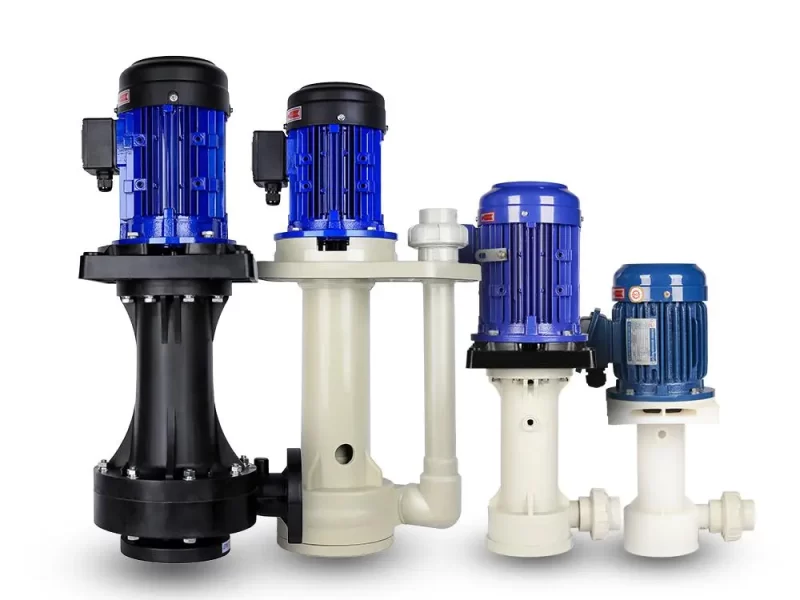
PCB wet processes include electroless copper, etching, copper plating, nickel/gold, tin, chemical silver, OSP, cleaning, developer, stripping, and exhaust-gas treatment. QEEHUA application materials list vertical pumps as a relevant product family for PCB, electroplating, coating, and scrubber systems. The installation must still be checked with real tank dynamics, not only product suitability.

A practical level-setting example
Use a short calculation before commissioning. It keeps the level decision visible and prevents operators from relying on memory.
Example: The pump supplier gives a minimum liquid level of 260 mm above the pump inlet reference point. The process team expects 40 mm of normal drawdown before replenishment, 30 mm of surface movement from return turbulence, and 20 mm of foam risk during high-load operation. A practical alarm level should be no lower than 260 + 40 + 30 + 20 = 350 mm above the same reference point. The hard shutdown level should still be set before unstable flow begins, not at the moment the inlet is exposed.
This example does not replace the pump drawing. It shows the logic. Engineers should use the actual QHA or QHD pump dimensions, tank geometry, and process liquid behavior. The more turbulent the tank, the more important the margin becomes.
For cavitation-sensitive systems, connect this level calculation to NPSH thinking. QEEHUA’s article on NPSH margin for PCB chemical pumps explains why liquid level, vapor pressure, suction loss, and pump inlet conditions affect stability. A vertical pump may avoid some horizontal suction-pipe issues, but it can still ingest air or lose stable flow if the inlet zone is poorly designed.
Failure map: level, vortex, foam, or restriction?
When a vertical pump loses flow, do not replace the pump first. Identify which failure path is most likely. A fast fault map saves time and reduces repeated failures.
1. Vortex path
Look for a surface funnel above the pump inlet. Test at normal level, alarm level, and just above shutdown level. If the funnel appears only at lower level, raise the alarm point or improve baffling.
2. Foam path
Check whether the tank has surfactants, developer chemistry, stripping chemistry, or return turbulence. Foam can feed air into the pump even when the measured liquid level seems acceptable.
3. Restriction path
Compare clean-filter pressure with operating pressure after production. A rising pressure drop can reduce flow and make borderline inlet conditions visible.
4. Damage path
Inspect protection tubes, submerged bearings, fasteners, and casing surfaces. QEEHUA’s pain-point records note that corroded vertical pump protection tubes can allow liquid-side air entry.
Safety and environmental control also matter. NIOSH identifies sodium hydroxide and sulfuric acid as hazardous corrosive chemicals with skin, eye, and respiratory exposure concerns. PCB tanks may contain alkaline developer, alkaline stripping liquid, sulfuric acid copper plating solution, acid etchants, or scrubber chemicals. The CDC/NIOSH pages for sodium hydroxide and sulfuric acid support the basic point: leakage, splashing, and uncontrolled maintenance around chemical tanks need real controls.
Material and protection choices
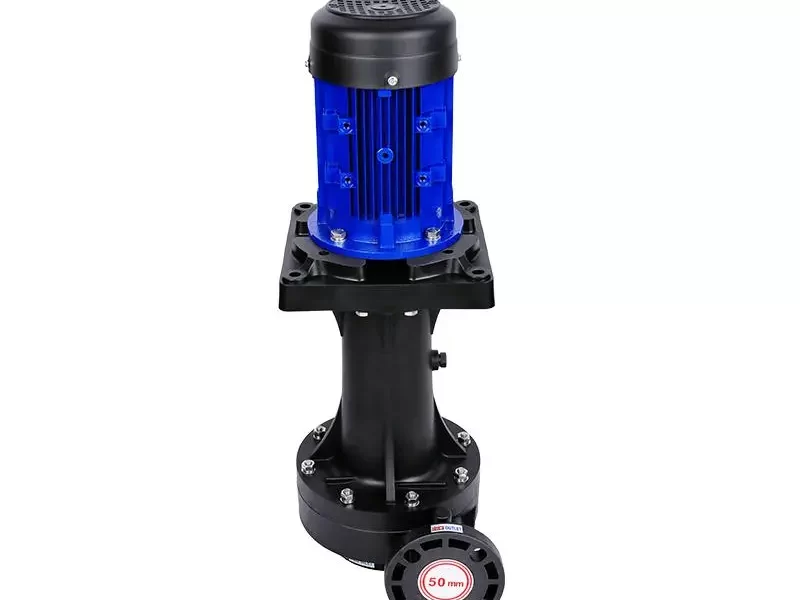
Submergence solves the hydraulic part. Material selection protects the pump in the chemical environment. QEEHUA product knowledge lists vertical pump materials including PPH, FRPP, PVDF, CFRETFE, and stainless steel options. It also notes that plastic vertical pumps are suitable for many acid and alkali liquids, while PVDF is useful in chemical plating and easy-crystallization liquids because of its smooth surface and stronger chemical resistance.
Stainless steel needs caution. QEEHUA training material states that stainless vertical pumps are not suitable for chloride-containing liquids and most acidic chemicals, and are mainly used in alkaline environments. For PCB lines, the engineer should not choose stainless only because it looks strong mechanically. Chemical compatibility is the first gate.
| Material or protection point | Quantified way to specify it | Field risk if missed |
|---|---|---|
| PVDF or CFRETFE wet-end need | List chemical name, concentration, temperature, and maximum upset temperature | Wrong plastic selection can lead to corrosion, swelling, or contamination. |
| Protection tube inspection | Monthly for severe acid/alkali tanks, or shorter if corrosion marks appear | A perforated submerged tube can create hidden air entry and unstable flow. |
| Low-level interlock | Test during commissioning and after sensor replacement | A sensor that is never tested may fail exactly when drawdown happens. |
| Current or flow alarm | Record baseline amperage and flow at normal level and low level | Operators can spot air ingestion or restriction before full flow loss. |
Protection logic should match the risk. Low-level switches, current monitoring, flow switches, and pressure alarms all help, but they must trigger early enough. If the low-level alarm sits below the point where vortexing begins, the alarm protects only after the pump has already run unstable. For related control logic, see QEEHUA’s article on PCB pump interlock logic.
Commissioning record template
A vertical pump should be commissioned under real tank conditions, not only with a short clean-water spin. The liquid level, chemistry, temperature, foam, filter pressure, and return flow should represent production as closely as practical. If the system is too risky for full-chemical testing at first, use staged testing and document the remaining assumptions.
Record these 12 values before release: tank ID, pump model, liquid name, operating temperature, normal liquid level, alarm level, shutdown level, measured flow, clean-filter pressure, dirty-filter changeover pressure, motor current, and observed vortex/foam condition.
If the line uses filtration, connect the pump check to the filter check. A clogged filter raises pressure and can move the pump away from its normal operating point. A bypass valve can hide the issue while sending unfiltered liquid back to the tank. QEEHUA’s PCB plating filter RFQ checklist is useful when buyers need to specify pump flow, micron rating, pressure drop, and maintenance access together.
Wastewater and chemical containment should also appear in the specification. EPA includes printed circuit board manufacture, electroplating, electroless plating, chemical etching, and related operations within the metal finishing context. The EPA Metal Finishing Effluent Guidelines are a useful reminder that leaks, drain-down, and uncontrolled discharge are process-management issues, not only pump-room housekeeping.
For QEEHUA product fit, use one vertical pump family page as the starting reference, then confirm details with the actual bath and tank drawing. For plastic chemical duty, the QEEHUA plastic and chemical vertical pump page is a relevant product entry point. Provide liquid name, concentration, temperature, tank depth, liquid-level range, flow, head, solids risk, and whether the pump sits inside or outside the tank.
FAQ
How much liquid level does a vertical pump need above the inlet?
Use the manufacturer’s minimum level as the base, then add margin for drawdown, foam, return turbulence, filter pressure changes, and process upset conditions. The practical level is the lowest level with no vortex or air ingestion.
What does a vortex above a vertical pump mean?
A vortex means surface liquid is rotating down toward the inlet. It can pull air into the pump, reduce flow, increase vibration, and damage bearings or impeller surfaces over time.
What is a useful low-level commissioning test?
Run the pump at the lowest permitted operating level for 10-15 minutes. Confirm no visible vortex, no discharge bubbles, stable current, stable flow, and correct low-level alarm response.
Why does flow drop even when the tank still has liquid?
The pump may be pulling foam or air, the inlet may be too close to surface swirl, the filter may be clogged, or gas may be trapped in the discharge line. Check level, inlet zone, pressure, and venting together.
Which vertical pump material is best for PCB wet process tanks?
There is no universal best material. PPH, FRPP, PVDF, CFRETFE, and stainless options depend on the liquid, concentration, temperature, chloride content, solids, and cleanliness requirement.
Sources
- NIOSH Pocket Guide: Sodium hydroxide
- NIOSH Pocket Guide: Sulfuric acid
- EPA: Metal Finishing Effluent Guidelines
Need help checking vertical pump level, material, and protection logic for a PCB tank? Email QEEHUA at info@qeehua.com with your tank drawing, liquid level range, flow, head, and chemical data.
Final note: A stable vertical pump installation depends on both geometry and chemistry. Set normal, alarm, and shutdown levels as numbers. Then prove them with a low-level run test, flow record, pressure record, and visual vortex check before production boards are on the line.