



A PCB plating filter RFQ should specify the bath chemistry, tank volume, target circulation rate, required micron rating, expected pressure-drop limit, pump flow, filter housing material, cartridge material, venting method, bypass arrangement, and maintenance access. Without those details, the supplier can only quote a generic chemical filter, and the line may suffer low flow, high differential pressure, particle carryover, leaking seals, or avoidable downtime after installation.
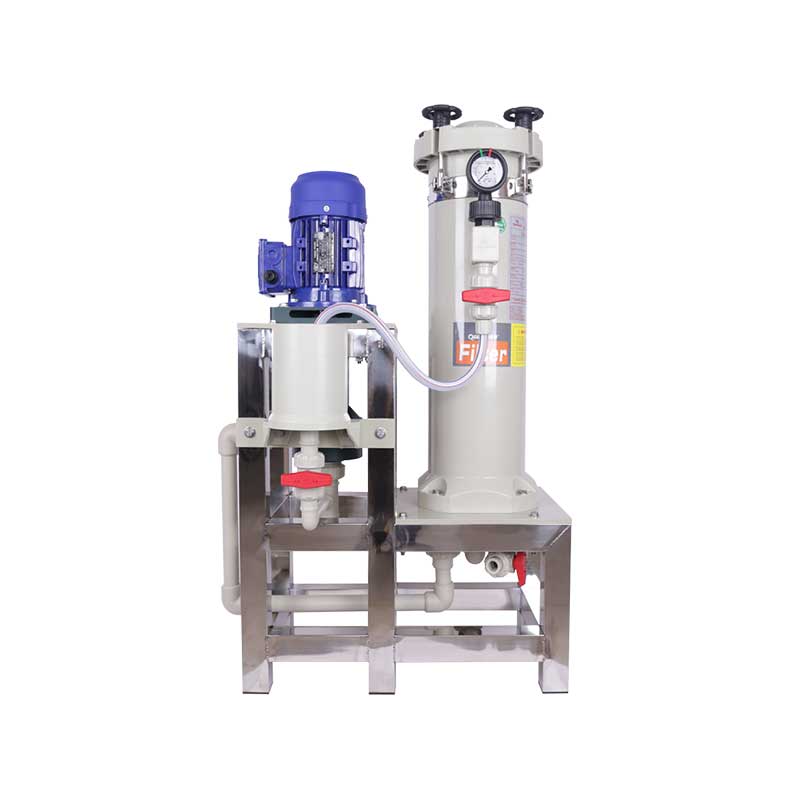
This checklist is written for PCB wet process lines, electroplating tanks, electroless nickel systems, chemical gold lines, and surface-treatment equipment builders. It turns the practical problems seen in plating rooms into RFQ fields that a buyer, equipment engineer, or maintenance manager can send before selecting a filter and pump package. For a broader product starting point, QEEHUA’s chemical filter range shows the types of filter housings commonly used for corrosive circulation and precision filtration.
Why RFQ Details Matter
Filtration is not just a filter canister added after the pump. In PCB and plating lines, the filter and pump decide how fast contaminants leave the bath, how stable the spray or circulation loop remains, and how often operators must stop production to replace cartridges. A vague RFQ such as “chemical filter for plating tank” leaves too many engineering choices open.
Metal finishing and PCB manufacture are also regulated process categories in many markets. The U.S. EPA describes metal finishing as including operations such as electroplating, electroless plating, chemical etching, and printed circuit board manufacture, and it connects those operations with wastewater controls and pretreatment requirements. That does not mean every filter RFQ is a compliance document, but it explains why buyers should record chemistry, solids loading, discharge path, and maintenance waste clearly. The EPA metal finishing effluent guidance is useful background when a plant is reviewing wastewater and process-fluid responsibilities.
A good RFQ should also separate process performance from safety. If the bath contains chromic acid, acid mist, strong oxidizers, cyanide chemistry, or hot alkaline cleaner, the supplier needs material and operating-limit information. OSHA notes that hexavalent chromium exposure may occur from dusts, mists, fumes, and contact routes, and that employers should use feasible engineering and work-practice controls. That is a reminder to include splash containment, venting, acid-mist location, and maintenance isolation in the purchasing discussion, not only flow rate.
Start With Process Data
The fastest way to improve a filter quotation is to describe the process in measurable terms. Begin with the tank and bath, not the equipment model. The same filter housing can behave very differently in acid copper, bright nickel, electroless nickel, developing solution, etching solution, or precious-metal plating because the solids, viscosity, crystallization tendency, temperature, and corrosion risks are different.
Use the first page of the RFQ to state the line type, bath name, tank volume, working temperature, pH or chemical family, target cleanliness, operating hours, and available space. If the buyer cannot disclose the exact formula, they should at least identify the chemical class: strong acid, strong alkali, oxidizing bath, fluoride-containing bath, solvent-containing bath, or precious-metal bath. QEEHUA’s local material notes distinguish common choices such as PPH, PVDF, carbon-fiber-reinforced PTFE, FEP/PFA, SUS 304/316/316L, EPDM, FKM, ceramic, and silicon carbide. Those choices matter because one material can be acceptable in a mild acid rinse but fail quickly in a hot oxidizing or fluoride-containing bath.

| RFQ field | What to provide | Why it matters |
|---|---|---|
| Bath and process | Acid copper, nickel, chrome, EN, chemical gold, developer, etching, rinse, or pretreatment | Determines corrosion risk, solids type, cartridge material, and cleaning method |
| Tank volume | Working volume in L or m3, not only nominal tank size | Lets the supplier estimate required turnover and pump flow |
| Temperature | Normal, maximum, and cleaning temperature | Controls plastic, seal, cartridge, and motor selection |
| Particles or defect target | Residue, anode slime, nickel plate-out, dust, fibers, rough plating, pinholes, or short circuits | Connects filtration precision with the real production problem |
| Operating pattern | Continuous, batch, standby, one-shift, or 24-hour operation | Changes cartridge life, pump duty, bypass need, and spare-unit planning |
Flow, Pressure, and Filter Size
For most plating and PCB filtration RFQs, the supplier needs both target circulation and allowable pressure drop. A practical starting point is to state the desired tank turnovers per hour, then convert that into flow. Many plating rooms use a target such as two to four bath turnovers per hour for general circulation, but the correct value depends on bath sensitivity, particle load, and production risk. Use the plant’s process standard when one exists.
The simple sizing formula is: required filter flow = working tank volume x target turnovers per hour. A 2,000 L tank at three turnovers per hour needs about 6,000 L/h through the filter loop. The selected pump should not be wildly larger than the filter rating. In QEEHUA’s internal pain-point data, oversizing the pump against the filter can damage cartridges, raise system pressure, and shorten filter life. A pump flow around the filter flow with a modest margin is safer than a pump that forces the housing into constant high pressure.
Pressure information should include normal clean-filter pressure, alarm pressure, cartridge change pressure, relief setting, and gauge location. If the RFQ only asks for a flow rate, the supplier cannot judge whether the selected cartridge area is enough. A filter that is too small may meet flow on the first day, then climb rapidly in differential pressure as particles load the media. This is why related QEEHUA troubleshooting articles such as electroplating filter pressure too high and PCB chemical filter short circuit should be treated as failure examples, not just maintenance topics.
Micron Rating and Cartridge Choice
Micron rating should come from the defect risk, bath type, and cartridge life target. Do not choose the smallest number only because it sounds cleaner. A very fine cartridge can remove smaller particles, but it may also block quickly, cause high pressure, starve circulation, and force operators to bypass the filter. That is worse than a slightly coarser, stable system that runs continuously.
QEEHUA’s pain-point table points to useful practical boundaries. Bright plating and precision PCB baths often require tighter filtration, while rougher pretreatment or etching loops may use coarser filtration to protect flow. For example, fine filtration around 0.5-1 micron may be requested for solder-mask, developing, or high-density PCB defect control, while 1-5 micron cartridges are common for bright nickel, acid copper, electroless copper, and chemical gold support. Coarser 5-10 micron choices may fit rough etching, pretreatment, or heavy-solids applications. The RFQ should make the target clear instead of letting the supplier guess.
| Bath or defect concern | Typical RFQ direction | Specification note |
|---|---|---|
| Solder mask, developing, HDI fine-line contamination | High precision filtration, often 0.5-1 micron where process rules require it | Ask for cartridge area and change pressure to avoid fast plugging |
| Bright nickel, acid copper, electroless copper, chemical gold | Fine filtration, commonly 1-5 micron depending on bath and supplier chemistry | Confirm compatibility with additives, temperature, and metal-ion sensitivity |
| Electroless nickel or crystallizing baths | Anti-clogging design, drainability, cleaning access, and suitable cartridge media | Specify plate-out or crystallization history, not only micron rating |
| Etching, pretreatment, heavy particle load | Coarser filtration or staged filtration may protect flow better | Consider bag prefilter plus cartridge final filter where solids are high |
| Shared or multi-tank systems | Dedicated circuits are preferred for sensitive baths | Include check valves, flushing plan, and cross-contamination controls |
If the bath already has a history of cartridge rupture, short cartridge life, or particles passing through, include that history in the RFQ. A supplier can then propose a stronger cartridge, larger filter area, staged filtration, better sealing, or a one-duty-one-standby layout. The article on shared electroplating filter cross-contamination is also relevant when one filter is expected to serve multiple tanks.
Material and Layout Checks
Material selection should be documented in the RFQ as a requirement, not left as a silent assumption. Plastic filter housings such as QH and QHC styles are common for corrosive plating and PCB wet process fluids. Stainless steel housings such as QHU-type filters can fit other chemical or finishing duties where stainless compatibility is confirmed. The RFQ should also state the seal material, valve material, gauge diaphragm material, pipe material, and any special requirement for metal-free wetted parts.
Use one product-page link in the RFQ or internal note, then keep the rest of the document technical. For example, a buyer comparing precision filter packages can reference the QH Series precision chemical filter while still specifying the bath, flow, cartridge, and layout conditions. This avoids a common procurement error: selecting a model name before confirming whether the process needs PP, PVDF, PTFE-lined, stainless steel, EPDM, FKM, or another wetted-part combination.
Layout checks to include in the RFQ:
- Is the filter dedicated to one tank, or shared between tanks?
- Where will the inlet, outlet, drain, vent, and pressure gauge be installed?
- Does the system need a bypass so maintenance can happen without stopping the tank?
- Will the filter sit near acid mist, spray, heat, or a cleanroom transfer path?
- Can operators drain and isolate the housing before opening it?
- Is there enough headroom to remove cartridges without tilting the housing?
Venting is often missed. If the vent valve or pressure gauge sits too low, air may remain inside the housing. That creates gas binding, flow instability, and false pressure readings. Drains are just as important in crystallizing baths. If operators cannot empty the housing after shutdown, residue can harden inside the cartridge or pipework. In high-risk chromium or acid-mist locations, connect these details with plant safety controls. OSHA’s hexavalent chromium exposure-control guidance gives useful context for why mists, contact routes, and work practices must be considered around plating operations.
Acceptance and Maintenance
An RFQ should describe how the buyer will accept the equipment after installation. Do not wait until startup to define success. The acceptance checklist should include leak testing, flow verification, pressure gauge reading, venting confirmation, cartridge seating, valve direction, pump rotation, motor protection, and safe drainage. If the line is continuous, ask the supplier whether a standby filter or bypass is needed for cartridge changes.
Maintenance records should also be part of the purchase discussion. Ask what pressure rise means a cartridge should be cleaned or replaced. Ask whether the cartridge can be washed, whether the spent cartridge becomes hazardous waste, and what spare parts should be stocked. If the RFQ also covers pump duty, compare the filter loop with QEEHUA’s pump curve versus system curve guide before confirming the operating point. In plating rooms, the lowest quote may become expensive if operators replace cartridges too often, lose production during cleaning, or cannot find compatible O-rings and gauge parts later.

| Acceptance item | Pass condition | Risk if ignored |
|---|---|---|
| Flow verification | Measured flow meets the specified turnover range at normal pressure | Bath particles remain in circulation or spray pressure becomes unstable |
| Pressure baseline | Clean-cartridge pressure is recorded after air is fully vented | Operators cannot tell normal loading from a blocked filter |
| Leak and drain test | Housing, valves, seals, and drain points stay dry during operation and shutdown | Chemical leakage damages floors, lines, instruments, or PCB panels |
| Cartridge seating | Center rod, cap, gasket, and cartridge direction are checked after installation | Particles bypass the cartridge and return to the bath |
| Spare-parts list | Cartridges, O-rings, gauges, valves, and pump wear parts are named in the order | Small failures turn into long downtime events |
A strong RFQ is therefore a risk-control document. It tells the supplier what must be protected: bath chemistry, board quality, pump life, worker access, wastewater responsibility, and production continuity. QEEHUA can help equipment builders and plating plants turn these operating details into a filter and pump selection for PCB, electroplating, surface treatment, and chemical circulation systems.
Need help preparing a filter and pump RFQ for a PCB or plating line? Send the bath name, tank volume, flow target, temperature, micron rating, and layout photo to info@qeehua.com and QEEHUA will review the basic specification points with you.
FAQ
What information should I send before asking for a PCB plating filter quote?
Send the bath name, tank volume, temperature, target turnovers per hour, required micron rating, pump flow, chemical compatibility needs, available space, and whether the filter must run continuously during production.
Should the pump flow be higher than the filter flow?
The pump needs enough margin to overcome piping and cartridge resistance, but excessive pump flow can create high pressure, cartridge damage, bypass leakage, and short filter life. Match pump and filter capacity as one system.
Is a lower micron rating always better for PCB filtration?
No. A lower micron rating can improve particle capture, but it can also plug faster and reduce circulation. Choose the rating based on defect risk, bath solids, cartridge area, and acceptable pressure rise.
When should a plating line use staged filtration?
Use staged filtration when solids loading is high, fine cartridges block quickly, or particles include larger debris and fine contamination. A coarse prefilter can protect the final cartridge and keep circulation stable.
Why does the RFQ need vent and drain details?
Vents remove trapped air that causes gas binding and false pressure readings. Drains let operators empty the housing before maintenance and reduce crystallization, leakage, and chemical exposure risk.