



Sodium hydroxide is widely used in PCB wastewater neutralization, scrubber pH control, and acid waste treatment. The pump selection problem is not only chemical resistance. Caustic concentration, viscosity, crystallization risk, pH control deadband, dosing accuracy, and operator exposure all affect the correct pump and control package.
NIOSH lists sodium hydroxide exposure limits of 2 mg/m3 and an IDLH value of 10 mg/m3. Those numbers are worker exposure values, not pump sizing values, but they explain why leaks, splashes, and maintenance access matter. A caustic dosing system should be specified from concentration, flow demand, target pH, and response time, not only from tank size.
Why Caustic Dosing Is Not Simple
Caustic soda reacts strongly with acid streams and can overshoot pH when the dosing point has poor mixing. It can also crystallize or become too viscous at lower temperatures, especially in strong solutions. A pump that is acceptable for warm, dilute neutralization may be poor for concentrated caustic transfer from a storage tank.


Self-review summary: technical review avoided claiming one pump type fits all caustic duties. SEO/GEO review focused the article on sodium hydroxide neutralization dosing rather than generic alkali transfer.
Numbers To Send
| RFQ field | Quantified value | Why it matters | Risk if omitted |
|---|---|---|---|
| NaOH concentration | 25%, 32%, 45%, 50%, or actual value | Changes viscosity, freezing/crystallization risk, and material stress | Pump selected as if solution were water |
| Wastewater flow | m3/h average and peak | Defines dosing range and response speed | Undersized pump cannot correct pH during peak acid load |
| Target pH band | Example: pH 8.5-9.5 | Defines control deadband and dosing accuracy | Overshoot causes repeated acid/alkali correction |
| Injection point | Pipe diameter, mixer, tank volume, retention time | Mixing controls pH sensor response | Pump appears unstable because sensor lags |
| Temperature | Minimum storage and dosing temperature | Strong caustic can become harder to pump when cold | Morning startup flow is lower than design |
| Controls | pH signal, flow pacing, low level, leak alarm, calibration interval | Turns dosing into a controlled loop | Manual adjustment creates pH swings |
If the system is part of a broader wastewater line, compare the pump demand with QEEHUA’s PCB wet process flow-rate calculation. For pump material and chemical service boundaries, start from the magnetic drive pump chemical selection guide.
Pump And Material Choice
Metering pump fit
- Small controlled injection flow.
- pH loop requires repeatable dose.
- Flow pacing from wastewater signal.
- Backpressure valve and calibration column available.
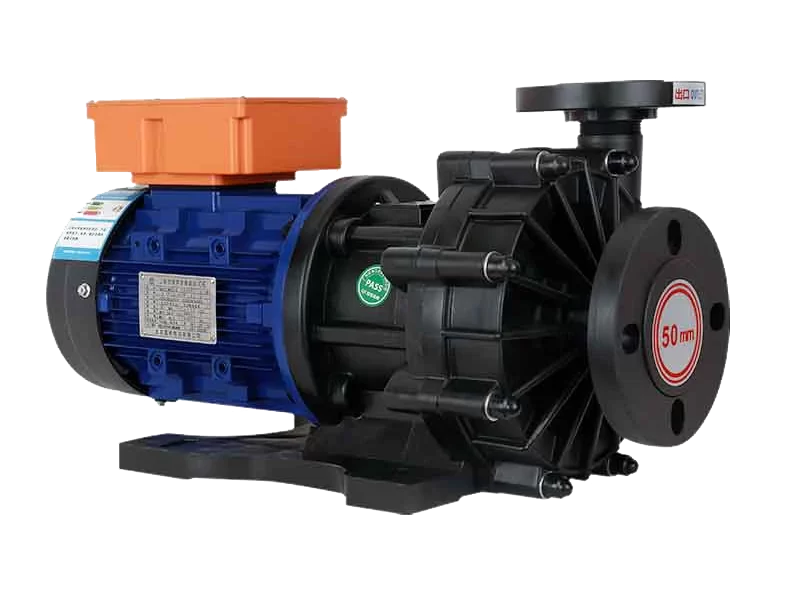
Centrifugal or magnetic pump fit
- Bulk transfer from storage to day tank.
- Recirculation of compatible alkali solution.
- Higher flow than metering pump range.
- Clear suction and leak control are required.

Worked Dose Check
Assume a wastewater neutralization tank receives 8 m3/h average flow and the process engineer estimates caustic demand at 1.2 L of 32% NaOH per m3 under normal acid load. Peak acid load can be 1.8 times normal for 20 minutes after dump events.
Normal dose = 8 m3/h x 1.2 L/m3 = 9.6 L/h. Peak dose = 9.6 L/h x 1.8 = 17.3 L/h. A practical metering pump range should cover the peak while still controlling smoothly near normal demand.
The pump should not be selected at the maximum stroke all the time. If normal operation is below 20-30% of pump range, pH control may pulse too coarsely. If peak demand is above 90% of range, the system has little margin for stronger acid loads.
Commissioning Control
Verify sensor slope and buffer readings before tuning the dosing pump.
Prime with splash protection and compatible tubing.
Start with a defined band such as pH 8.5-9.5, then tune by site data.
Measure mixing time between injection and pH sensor response.
Use high pH, low pH, low tank level, and leak alarms.
Log L/h, pH trend, wastewater flow, and chemical consumption per shift.

If caustic leaks are related to elastomer swelling, use QEEHUA’s O-ring swelling checklist. If pump stops are tied to low tank level, compare with QEEHUA’s dry-running protection article.
Source Notes
NIOSH lists sodium hydroxide as caustic soda or lye, with a ceiling REL of 2 mg/m3, OSHA PEL of 2 mg/m3 TWA, and IDLH of 10 mg/m3. EPA metal finishing guidance is relevant because PCB manufacturing and metal finishing wastewater systems can include neutralization and treatment steps.
FAQ
What pump is best for sodium hydroxide neutralization dosing?
For controlled low-flow dosing, a metering pump is often preferred. For bulk caustic transfer to a day tank, a compatible centrifugal or magnetic pump may fit better. The decision depends on concentration, flow range, pH control, and suction condition.
Why does caustic dosing overshoot pH?
Common causes are oversized pump stroke, poor mixing, pH sensor delay, too narrow a deadband, high caustic concentration, or lack of flow pacing from the wastewater stream.
What data should be sent for a sodium hydroxide dosing pump?
Send NaOH concentration, wastewater flow, target pH band, tank volume, retention time, injection point, minimum temperature, required dose range, and alarm requirements.
If the dosing line shows pulsing or unstable injection, review QEEHUA’s chemical metering pump pulsation article before changing only the caustic concentration.
Need a sodium hydroxide dosing pump review? Send QEEHUA the NaOH concentration, wastewater flow, target pH, dose estimate, tank volume, and control signals. Contact QEEHUA at info@qeehua.com for a neutralization pump check.
Sources
- NIOSH Pocket Guide: Sodium hydroxide
- OSHA Occupational Chemical Database: Sodium hydroxide
- EPA Metal Finishing Effluent Guidelines
Final note: caustic dosing pump selection is a control problem as much as a chemical compatibility problem. Concentration, dose range, pH response, and mixing time must be visible before the pump is chosen.