



Total dynamic head for PCB wet process chemical pumps is the head a pump must overcome at the required flow rate. It includes static lift, pressure difference, pipe and fitting loss, filter or spray-header loss, and a chemical-specific correction for pressure conversion. For a broader head-versus-pressure explanation, see QEEHUA’s guide to pump pressure and head formulas. This article turns that concept into a PCB wet-process sizing worksheet.
PCB developing, etching, micro-etching, electroplating, ENIG, stripping, cleaning, and filtration lines rarely behave like a short clean-water pipe. They have filters, valves, spray headers, elbows, reducers, long horizontal runs, and chemicals with different specific gravity. A pump that only matches the catalog flow may miss the real duty point after it enters the line.
The TDH formula for PCB chemical pumps
Use total dynamic head as a practical sizing target. It lets the buyer compare the system requirement with the pump curve at the planned flow rate. The Hydraulic Institute explains that a system curve combines static head and frictional head losses across the flow range in its pump system curve reference.
TDH = static head + pressure head + pipe friction head + equipment loss head + safety allowance
Head from pressure in meters = pressure in kPa / (9.81 × specific gravity)
Do not calculate TDH at zero flow. Calculate it at the target process flow. Friction loss rises quickly as flow rises. A line that looks acceptable at low flow may require much more head at the production flow. Pumps & Systems also warns in its pump sizing guidance that friction loss must be determined at the design flow rate.
Data to collect before sizing the pump
Before asking for a pump model, collect the line data. This reduces oversizing, undersizing, and repeated pump changes after commissioning.
- Target circulation flow in L/min or m3/h.
- Tank liquid level relative to the pump centerline.
- Highest discharge point, spray header, filter inlet, or return point.
- Pipe size, pipe length, elbow count, valve count, and reducer details.
- Filter housing type, clean pressure drop, and dirty pressure-drop limit.
- Chemical name, concentration, temperature, and specific gravity.
- Whether the system has a check valve, bypass, flowmeter, pressure gauge, or control valve.

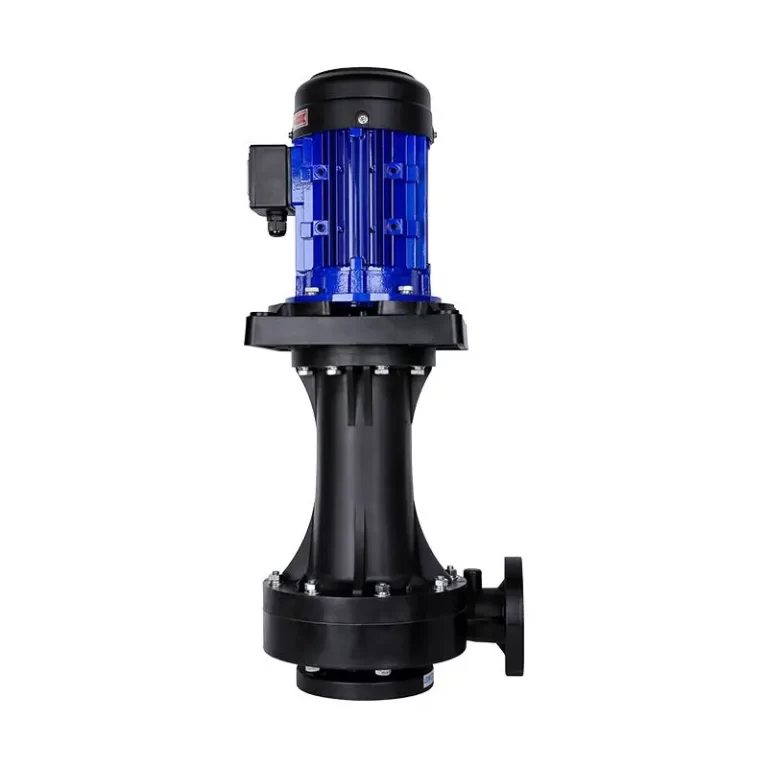
Local PCB line checks matter. QEEHUA application notes show that suction piping smaller than the pump inlet can reduce etching flow. They also warn that uphill suction piping can trap air and make flow unstable. If the suction side has this problem, solve it before treating the issue as a head shortage. For that installation angle, see the article on PCB pump suction piping air pockets.
Worked example for a PCB filtration loop
The example below is not a universal design. It shows the calculation logic for a PCB filtration or circulation loop where the pump sends liquid through a chemical filter and back to the tank or spray section.
| TDH input | Example value | How to convert it | Head added |
|---|---|---|---|
| Static elevation difference | Return point is 1.8 m above pump centerline | Direct elevation difference | 1.8 m |
| Pipe and fittings | Estimated from pipe size, elbows, valves, and flow | Use line-loss data or supplier calculation | 3.5 m |
| Clean filter pressure drop | 35 kPa at target flow | 35 / (9.81 × 1.15 SG) | 3.1 m |
| Dirty filter allowance | Additional 25 kPa before cartridge change | 25 / (9.81 × 1.15 SG) | 2.2 m |
| Spray header or control valve requirement | 50 kPa residual pressure needed | 50 / (9.81 × 1.15 SG) | 4.4 m |
| Safety allowance | About 10% for normal uncertainty | Use only after checking the curve | 1.5 m |
| Estimated TDH | At the target flow | Sum of the above items | 16.5 m |
This calculation shows why a pump with a 16 m shutoff head is not enough. The pump must deliver the target flow at about 16.5 m head. If the pump curve only reaches that head near zero flow, the real line will still run short of circulation.
The chemical’s specific gravity changes pressure conversion. A filter pressure drop of 50 kPa means less head in a heavy liquid than in water, but the pump motor still sees higher hydraulic power demand. Engineering Toolbox gives a useful pressure-head relationship in its pump head and pressure conversion guide. For corrosive PCB liquids, also confirm that the pump material, shaft, bearing, and O-ring match the bath.
How TDH changes the pump curve decision
A pump curve is not a single number. It is a flow-versus-head relationship. The operating point sits where the pump curve meets the system curve. If the filter gets dirty, if a valve closes, or if the pipe is smaller than expected, the system curve moves upward. Flow then falls.
This is why TDH work should be done before blaming the pump. A line may look like a pump-capacity problem when the true cause is filter pressure, blocked suction, wrong valve sequence, or water hammer protection that adds too much loss. QEEHUA’s article on PCB wet process water hammer explains why fast valve action can also create pressure shock instead of stable circulation.
For PCB wet processes, avoid selecting a pump far from its reasonable operating range. If the pump is too small, spray pressure or filtration turnover may fall. If the pump is too large, the line may need throttling, the filter may see excessive pressure, and the chemical bath may foam or entrain air. The better target is a stable operating point with enough margin for dirty-filter pressure and normal line variation.
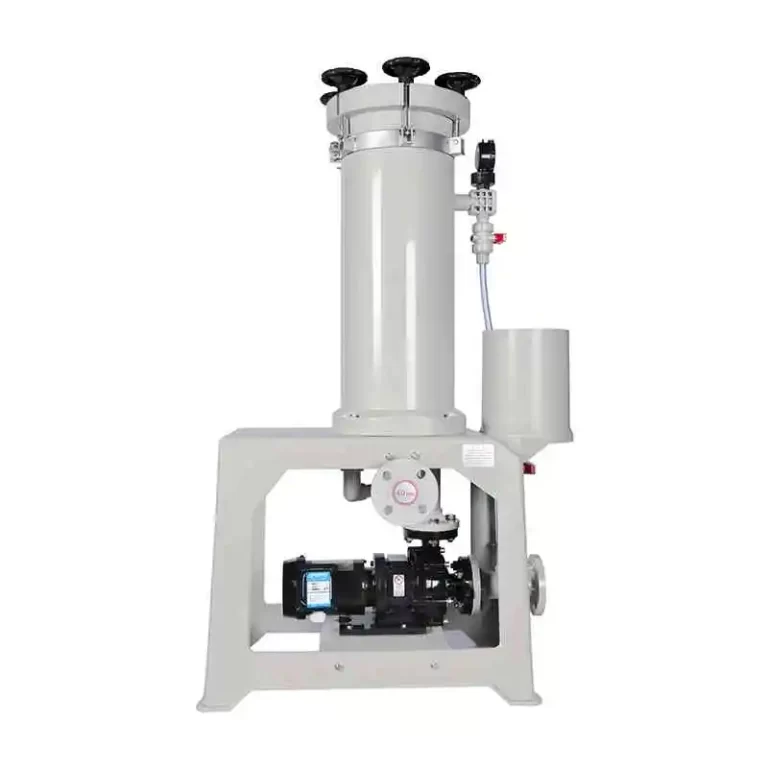
RFQ checklist for QEEHUA pump selection
When sending a request for pump selection, include the calculation inputs instead of only asking for a flow rate. This gives the supplier enough context to check the pump curve, material, bearing structure, seal arrangement, and filter match.
- Required flow rate and whether it is continuous or intermittent.
- Estimated TDH or enough data to calculate it.
- Chemical name, concentration, temperature, and specific gravity.
- Pipe size, pipe length, elevation difference, filter model, and pressure-drop limit.
- Expected operating mode: circulation, filtration, transfer, spray, dosing support, or wastewater treatment.
- Known risks: crystallization, particles, gas entrainment, dry running, foaming, or high acid mist.
If the loop is mainly a PCB filtration line, pair the TDH calculation with the guidance in QEEHUA’s PCB wet process filtration and chemical filter pump selection article. If leakage control is the main requirement, one suitable starting point is QEEHUA’s magnetic pump product range, but the final model still depends on the calculated duty point and chemical compatibility.
Need help checking a PCB chemical pump duty point? Send the flow rate, pipe layout, filter pressure drop, chemical data, and target operating mode to info@qeehua.com. QEEHUA can review the TDH inputs before pump selection.
FAQ
Is total dynamic head the same as pump discharge pressure?
No. Discharge pressure is one measured condition. Total dynamic head is the full system requirement at a target flow rate. It includes elevation, pressure requirement, pipe loss, filter loss, fitting loss, and allowance.
Should PCB plants calculate TDH with clean filter pressure or dirty filter pressure?
Use both. Clean pressure shows startup behavior. Dirty-filter pressure shows whether the pump can still deliver enough flow before the cartridge or bag reaches its change point.
Why does specific gravity matter when converting pressure to head?
Specific gravity changes the pressure-to-head conversion. The same pressure reading represents a different liquid-column height when the chemical is heavier or lighter than water.
Can QEEHUA select a pump if the buyer does not know pipe friction loss?
Yes, if the buyer provides pipe size, pipe length, fittings, valves, flow rate, filter data, and chemical details. QEEHUA can help estimate the duty point from those inputs.
What is the most common TDH mistake in PCB wet process pump selection?
The common mistake is choosing by flow only. The pump must deliver that flow at the real TDH after pipe loss, filter pressure drop, spray requirement, and chemical specific gravity are considered.